



Attachment styles are patterns of relating to intimacy and connection that develop in early childhood based on the quality of emotional bonds with primary caregivers. The four main styles — secure, anxious, avoidant, and disorganised — describe how a man approaches closeness, responds to conflict, handles the fear of abandonment, and regulates his emotional experience within relationships. These patterns operate largely outside conscious awareness but can be understood, worked with, and shifted through therapeutic support.
There’s a pattern most men have never examined — and it’s running their most important relationships without their awareness.
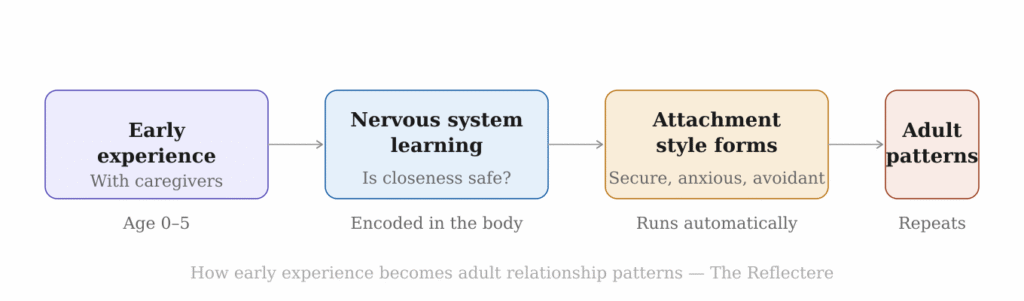
It’s not a bad habit they picked up in adulthood. It’s not a communication style they could swap out with a book or a weekend course. It’s something older than that. Something that formed in the earliest years of their life, when they were entirely dependent on the people around them to survive — and whose emotional availability, or lack of it, taught their nervous system something fundamental about what closeness means and what it’s likely to cost.
That early learning is called attachment. And understanding it is one of the most significant things a man can do to change how he shows up in his relationships.
What Attachment Theory Actually Is
In the 1950s and 60s, British psychiatrist John Bowlby developed attachment theory — the idea that human beings are biologically wired to seek proximity to caregivers for safety and survival, and that the quality of those early bonds shapes psychological development in lasting ways.
Later, researcher Mary Ainsworth identified specific patterns in how children respond to their caregivers — patterns that have since been mapped onto adult romantic relationships with remarkable consistency.
The key insight is this: what a child learns about the safety of closeness in his earliest relationships becomes a template he carries into every significant relationship that follows. Not consciously. Not deliberately. But reliably.
The man who pursues and panics when his partner pulls away. The man who goes quiet and cold at exactly the moment he’s most needed. The man who wants intimacy desperately and keeps choosing people who can’t give it to him. The man whose relationships cycle between intensity and collapse.
All of these are attachment patterns. And all of them began somewhere.
The Four Attachment Styles
Secure Attachment
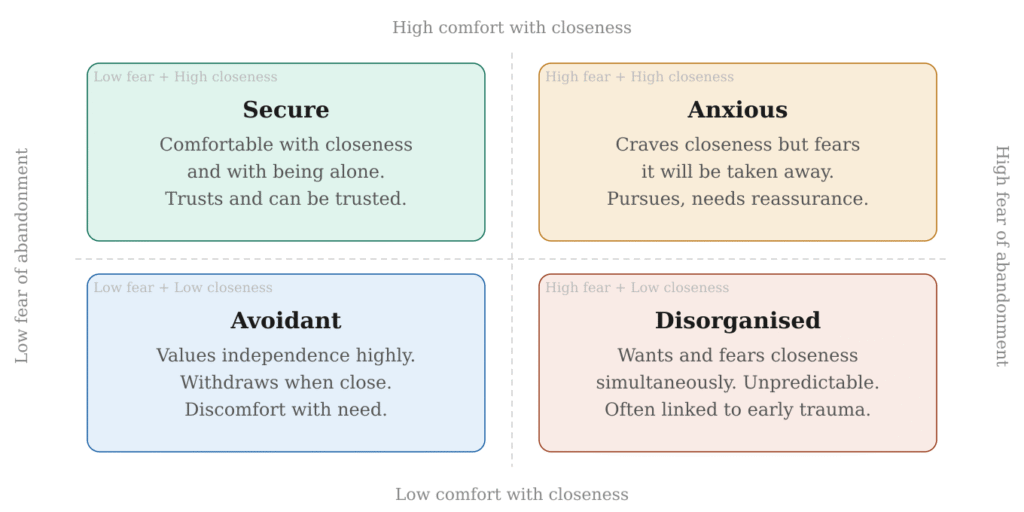
A securely attached man is comfortable with intimacy and equally comfortable with his own independence. He can ask for support without it feeling like weakness and can offer support without losing himself. He handles conflict without catastrophising — he believes the relationship can survive disagreement.
Secure attachment develops when a child has caregivers who are consistently warm, responsive, and available. Not perfect — consistently good enough. The child learns that when he needs something, reaching out works. That closeness is safe. That he matters.
Men with secure attachment aren’t without difficulty in relationships. But they have a fundamentally stable foundation — the relationship is a secure base rather than a source of chronic anxiety.
Anxious Attachment
A man with an anxious attachment style craves closeness intensely but lives in chronic fear that it will be taken away. He is highly attuned to his partner’s emotional state — reading shifts in mood, interpreting distance as rejection, and often seeking reassurance in ways that can feel overwhelming to the other person.
Anxious attachment typically develops when caregiving was inconsistent — sometimes warm and available, sometimes not. The child learned that he had to work hard for closeness — to perform, to monitor, to pursue — because the availability of care was unpredictable.
As an adult, this shows up as the man who panics when his partner doesn’t respond quickly enough. Who escalates in conflict rather than withdrawing. Who needs to know where things stand, constantly. Whose love is intense and whose fear of loss is equally intense.
The anxiety isn’t irrational. It’s learned. And it made sense in a relational environment where care was genuinely uncertain.
Avoidant Attachment
A man with an avoidant attachment style values his independence highly and becomes uncomfortable when relationships require too much emotional closeness. He tends to withdraw when things get intense — shutting down, going quiet, pulling back. He may not fully recognise how much he’s doing this or how significant the impact is on those who love him.
Avoidant attachment typically develops when caregivers were consistently emotionally unavailable — not necessarily cold or abusive, but not attuned. The child learned that needing things didn’t produce results. That self-sufficiency was the safer strategy. That emotional need was, at best, irrelevant — and at worst, a burden.
As an adult, this becomes the man who needs a lot of space. Who dismisses emotional conversations. Who feels crowded by a partner’s needs. Who has a high external function and a significant internal distance. Who doesn’t fully understand why the people who get closest to him eventually leave — or shut down.
This is the most common attachment pattern in men. And it’s the one most likely to go unrecognised — because independence and self-sufficiency are so culturally valued that the underlying relational avoidance gets framed as a personality trait rather than a pattern worth examining.
Disorganised Attachment
A man with disorganised attachment both wants and fears closeness simultaneously. He may oscillate between pursuing intimacy intensely and pushing it away once it arrives. His relational patterns can feel confusing — to himself as much as to his partners.
Disorganised attachment typically develops in the context of early trauma or frightening caregiving — where the person who was supposed to provide safety was also a source of fear. The child’s attachment system was activated and terrified at the same time. There was no coherent strategy available.
As an adult, this can look like relationships that swing between intensity and collapse. An inability to settle. A self-sabotage pattern that destroys closeness when it finally arrives. A deep longing for connection paired with an equally deep terror of it.
Why Most Men Don’t Know Their Attachment Style
The most common response when men first encounter attachment theory is recognition — a quiet realisation that something they’ve been living with has a name.
But most men arrive at that recognition late, if at all. Several things get in the way.
The patterns feel like personality. Avoidance feels like independence. Anxiety feels like caring deeply. Disorganised relating feels like being complicated. Because the patterns are so thoroughly woven into how a man experiences himself, they don’t present as something he does — they present as something he is.
The patterns are invisible under pressure. Attachment patterns activate most intensely under relational stress — conflict, perceived rejection, closeness that feels threatening. This is precisely the moment when a man has the least access to self-reflection. The pattern takes over before the awareness can catch up.
Nobody taught this. Most men have never been in a context where attachment was discussed, modelled, or explored. The vocabulary doesn’t exist in most male relational environments. So the pattern runs, unnamed, across every relationship a man has.
What Changes When a Man Understands His Attachment Pattern
Understanding attachment style doesn’t automatically change it. But it changes the relationship a man has with his own behaviour — which is where change becomes possible.
The avoidant man who recognises his pattern can start to notice when he’s withdrawing — not just as a feeling of needing space, but as a learned response to intimacy that has a specific origin and a specific cost. He can begin to ask: is this what I actually want, or is this what I learned to do?
The anxious man who understands his pattern can start to distinguish between a real threat to the relationship and an activated attachment system doing what it was taught to do. He can pause before the pursuit. He can notice the fear without being run by it.
Neither of these shifts happens overnight. They happen through consistent, supported work — through developing the capacity to stay present with the emotional experience that the attachment pattern is usually protecting against.
How Therapeutic Work Changes Attachment Patterns
The research on attachment is clear: styles are not fixed. They are the product of relational experience — and relational experience can produce new learning.
IFS is particularly effective here — helping a man understand the internal parts that drive his attachment behaviour. The part that withdraws at the first sign of closeness, and what it’s protecting. The part that pursues with such intensity that it pushes away the very connection it’s seeking. Working with those parts with curiosity rather than judgment begins to loosen their grip.
NARM works directly with developmental and relational trauma — addressing the early nervous system learning that produced the attachment pattern in the first place. Rather than focusing on past events, NARM works in the present — with how the pattern is showing up now, and what capacity already exists to respond differently.
Somatic therapy addresses the physiological dimension of attachment — because attachment patterns live in the body before they live in the mind. The tightening that happens when a partner gets too close. The surge of anxiety when a text goes unanswered. The collapse into numbness during conflict. Learning to stay present with those physical experiences — to feel them without being swept away — is a core part of how attachment security is built in adulthood.
The therapeutic relationship itself is one of the most powerful mechanisms of change. A consistent, attuned, non-judgmental relationship — with a therapist who can be depended upon to show up the same way, week after week — provides the corrective relational experience that attachment healing actually requires. Understanding the pattern helps. Having a different kind of relational experience in real time does something that understanding alone cannot.
You Didn’t Choose Your Attachment Style
The final thing worth saying is simple: the attachment style you developed is not your fault. It is the result of a relational environment you were born into and had no power to choose or change.
What you can choose — now, with awareness and support — is whether that pattern continues to run your most important relationships without your knowledge. Or whether you understand it clearly enough to start responding from a different place.
That’s not a small thing. For the men who do this work, it changes everything — the relationships they’re able to build, the closeness they’re able to sustain, the version of themselves they’re able to bring to the people they love.
Book your free 20-minute consultation here →
FAQ — Attachment Therapy for Men
What is an attachment style and where does it come from? An attachment style is a pattern of relating to intimacy and connection that develops in early childhood based on the emotional availability and consistency of primary caregivers. The nervous system learns from these early relational experiences whether closeness is safe, whether needs will be met, and what to expect from the people we depend on. This learning becomes a template — largely unconscious — that shapes how men approach relationships, handle conflict, and respond to intimacy throughout their lives.
What are the four attachment styles in men? The four main attachment styles are secure (comfortable with closeness and independence), anxious (craving closeness but fearing its loss), avoidant (valuing independence and withdrawing from emotional intimacy), and disorganised (simultaneously wanting and fearing closeness, often linked to early trauma). Most men have a primary style with elements of others. Avoidant attachment is the most common pattern in men, partly because cultural values around independence reinforce rather than challenge it.
Can attachment styles change in adulthood? Yes. Research consistently shows that attachment styles are not fixed. They developed through relational experience and can be changed through new relational experience — particularly in the context of therapeutic support. The therapeutic relationship itself is one of the most powerful mechanisms of change, providing the consistent, attuned presence that allows the nervous system to learn something different about what closeness means.
How does avoidant attachment show up in men? Avoidant attachment in men typically presents as a high need for independence, discomfort with emotional intimacy, withdrawal during conflict or when relationships become demanding, difficulty expressing emotional needs, and a tendency to minimise the significance of relational difficulties. Many avoidantly attached men don’t recognise this as a pattern — they experience it as simply being self-sufficient or independent, because those qualities are culturally valued rather than examined.
What therapy works best for attachment issues in men? The most effective therapeutic approaches for attachment work in men combine relational, body-based, and parts-based work. At The Reflectere, this includes IFS to understand the internal parts driving attachment behaviour, NARM for the developmental nervous system learning that produced the pattern, and Somatic Therapy to work with how attachment patterns are held physically in the body. The therapeutic relationship itself is a central mechanism of change.
Is attachment counselling available virtually for men in BC? Yes. The Reflectere offers virtual attachment counselling for men anywhere in British Columbia and parts of Canada. Sessions address attachment patterns using IFS, NARM, Somatic Therapy, and CBT and DBT for skills support. A free 20-minute consultation is available at thereflectere.janeapp.com.
The Reflectere offers in-person men’s counselling in Kelowna, BC and virtual counselling for men across British Columbia and Canada. Approaches include IFS, Somatic Therapy, NARM, CBT, and DBT.