


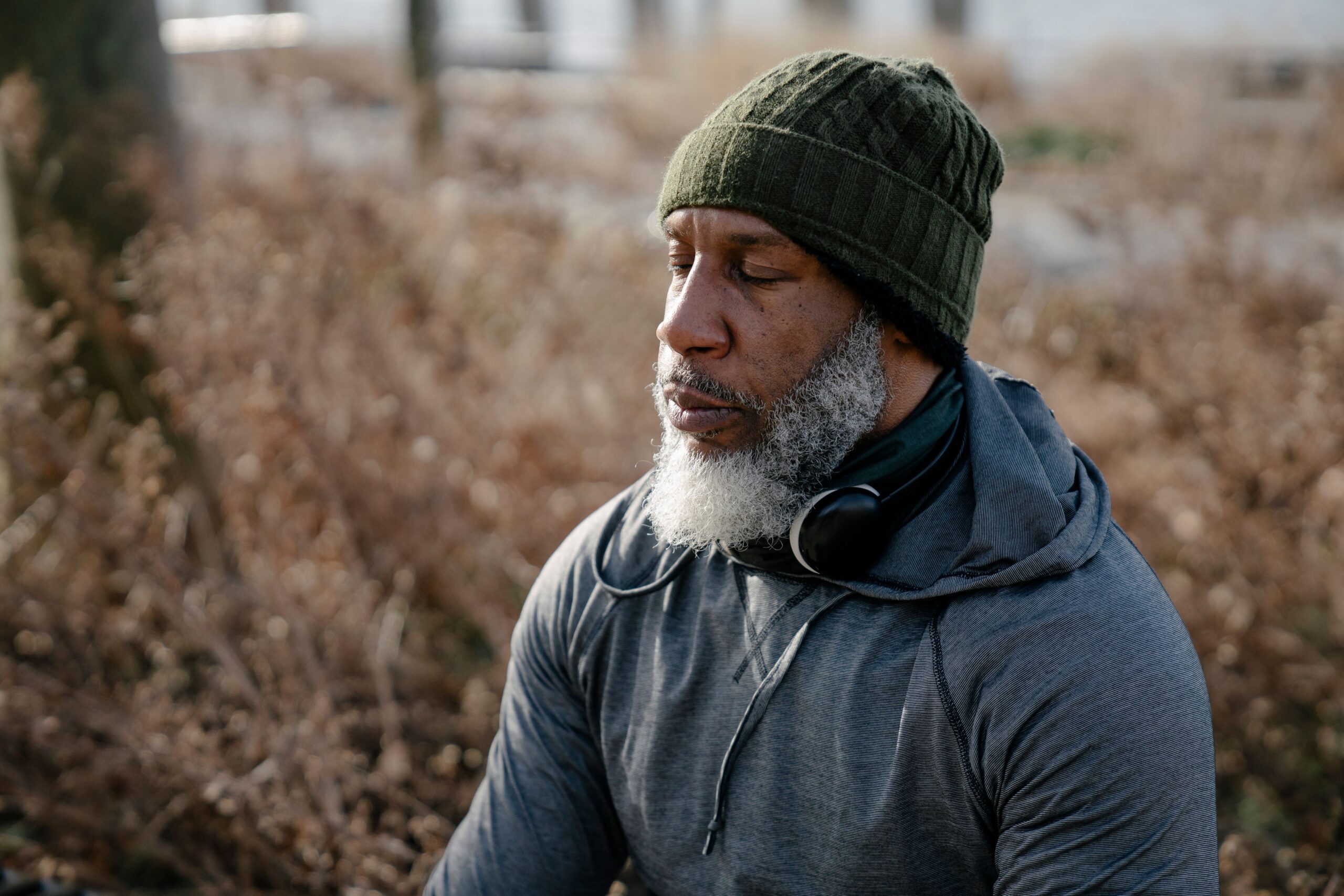
Grief in men rarely presents as visible sadness or mourning. It tends to show up as anger, emotional numbness, increased alcohol use, withdrawal from relationships, restlessness, or a chronic low-grade irritability that has no clear source. Because men are often conditioned to manage loss by staying functional and pushing through, grief frequently goes unprocessed — where it doesn’t disappear but instead accumulates, shaping a man’s emotional life, his relationships, and his sense of himself in ways he often can’t trace back to their origin.
Most men were never taught how to grieve.
They were taught how to function after loss. How to stay standing. How to keep showing up. How to be the strong one in the room while everyone around them processed what happened.
The grief itself — the actual, felt experience of loss — got managed, minimised, or set aside entirely. Because there was always something that needed doing. Because breaking down felt like a luxury. Because nobody around them modelled what it looked like for a man to actually mourn.
And so the grief went underground. Not gone. Just unaddressed.
This post is about what happens to grief that was never allowed to surface — and what it actually takes to move through it.
What Men Grieve
Before going further it’s worth naming what grief actually covers — because men often don’t recognise the breadth of what qualifies as loss.
The obvious ones are there: the death of a parent, a partner, a friend. The end of a marriage. The loss of a child.
But grief also lives in things that don’t get named as losses:
The career that didn’t happen. The father who was present but never really there. The version of yourself you had to give up somewhere along the way. The relationship that ended without closure. The opportunity that passed. The body that used to do things it can no longer do. The years that went by while you were busy surviving them.
These losses are real. They carry weight. And they deserve to be mourned. But because they don’t look like conventional grief, most men never recognise them as something they’re allowed to feel.
How Unprocessed Grief Shows Up in Men
As Anger
This is the most common and least recognised expression of grief in men. The man who is short-tempered, who carries a low-grade edge that never fully resolves, who seems perpetually frustrated with everything and nothing — he is often a man who is grieving without knowing it.
Anger is more tolerable than grief for most men. It has energy. It has direction. It restores a sense of power that grief strips away. So the nervous system reaches for anger instead, and the grief waits underneath, unaddressed.
As Numbness
The man who has shut down emotionally — who goes through the motions, who can’t feel the things he knows he should feel at moments that matter — is often a man who has been managing grief by not feeling it for so long that the capacity to feel has dimmed generally.
The numbness isn’t a character trait. It’s the result of a system that learned to close the door to painful experience and, over time, found the door difficult to open again.
As Restlessness and Compulsive Busyness
Some men grieve by never stopping. The relentless activity, the inability to sit still, the calendar packed so full there’s no space for anything quiet — this is often grief avoidance in motion. As long as there’s somewhere to be and something to do, the grief doesn’t get a foothold.
The cost is a life lived on the surface. Present everywhere and nowhere. Moving so constantly that nothing can catch up — including the man himself.
As Physical Symptoms
Unprocessed grief has a body. Chest heaviness, fatigue that doesn’t resolve, frequent illness, disrupted sleep — the body carries what the mind has been unwilling to feel. Many men seek medical attention for physical symptoms that have unprocessed grief at their root, without ever connecting the two.
As Complicated Relationships With the Lost Person
Men who haven’t fully grieved a significant loss often carry a complicated, frozen relationship with the person or thing they lost. The father who died before things were resolved. The relationship that ended with things unsaid. The version of themselves that never got to become what they’d hoped.
These unresolved relationships exert a quiet pull — shaping how a man relates to authority, to intimacy, to his own ambitions and limitations — without him ever tracing it back to the original loss.
The Specific Weight of Losing a Father
The loss of a father deserves its own section — because it carries layers that most other losses don’t.
When a father dies, a man doesn’t only lose a parent. He often loses the possibility of resolution. Of conversations that were always going to happen someday and now won’t. Of approval that was withheld and can no longer be given. Of questions about who he is and where he came from that can no longer be asked.
For men who had complicated relationships with their fathers — and most men did, in one way or another — the death can be one of the most disorienting experiences of their lives. Not just because of the loss itself, but because of the finality it places on everything that was unfinished.
The grief of losing a complicated father isn’t simple grief. It’s grief mixed with relief, with guilt about that relief, with anger at what wasn’t given, with sadness about what now can’t be said. It’s one of the most layered emotional experiences a man can move through — and one of the most poorly supported.
Why Men Don’t Let Themselves Grieve
It Was Never Modelled
Most men grew up watching the men around them respond to loss by staying functional. Their fathers went back to work. Their grandfathers didn’t speak of it. The cultural message was consistent: loss is something you absorb and continue, not something you stop for.
Without a model for what male grief looks like, most men don’t know how to do it. The feeling is there. The expression of it — the language, the permission, the safe container — isn’t.
It Feels Like It Will Break Something
Many men have a fear, often unspoken, that if they let the grief in fully it will overwhelm them. That they’ll fall apart in a way they won’t be able to come back from. That starting to cry means not being able to stop.
This fear is understandable, particularly for men who have spent years holding things together. But the containment of grief doesn’t prevent that overwhelming experience — it delays and compounds it. Grief that’s been managed for years tends to be more powerful when it finally surfaces, not less.
They Don’t Have the Space
Grief requires time, quiet, and relational safety — three things most men have in short supply. The demand to keep functioning, to remain available to the people who depend on them, to not burden others — all of it crowds out the space that grief needs.
This is where therapeutic support becomes specifically useful. Not as a place to be broken apart, but as a space specifically designed to hold what can’t yet be held elsewhere.
What Grief Actually Needs
Grief doesn’t need to be fixed. It needs to be felt — at a pace that’s manageable, in a container that’s safe, with support that doesn’t rush it toward resolution.
Permission — the first thing most men need is permission to grieve at all. To name the loss for what it is. To acknowledge that what they’re carrying is real, that it deserves attention, and that feeling it doesn’t make them weak or broken.
Time and space — grief doesn’t follow a timeline. It moves in waves, not in stages. It resurfaces when you don’t expect it. The work is not about processing it efficiently but about creating enough space that it can move through rather than remain stuck.
Witness — grief is relational. It needs to be seen. The most significant healing in grief work often happens not through insight or technique but through the experience of being with someone who can stay present with the weight of what you’re carrying without flinching or rushing you out of it.
Working with the body — grief is held physically. The tightness in the chest, the heaviness in the shoulders, the constriction in the throat — these are where grief lives before it has words. Somatic approaches work directly with that physical experience, helping grief move through the body rather than remain locked in it.
Understanding what was lost — sometimes the most important work in grief is naming what was actually lost — which is often more complex than it first appears. The death of a father who was never emotionally present isn’t only the loss of a person. It’s the loss of the relationship that was never had, and of the possibility of it ever being different.
Grief Is Not a Problem to Solve
The most important reframe for men approaching grief is this: grief is not a problem. It is love with nowhere to go.
The depth of grief is a measure of the depth of connection — even when that connection was complicated, even when the loss was of something that never fully existed, even when the feelings are mixed and confusing.
A man who can grieve — who can let loss be loss without immediately converting it into something more manageable — is a man with access to a fuller range of his own humanity. The capacity to mourn is inseparable from the capacity to love, to be present, and to feel the texture of a life that actually means something.
That capacity is not weakness. It may be one of the most significant forms of strength a man can develop.
Book your free 20-minute consultation here →
FAQ — Grief Counselling for Men
How does grief show up differently in men? Grief in men rarely presents as visible sadness or tearfulness. It tends to manifest as anger, emotional numbness, compulsive busyness, withdrawal from relationships, restlessness, increased alcohol use, and physical symptoms such as fatigue, chest heaviness, and disrupted sleep. Because these expressions don’t match the typical image of grief, men often don’t recognise what they’re experiencing as grief — and don’t receive appropriate support.
What is unprocessed grief and what does it do? Unprocessed grief is loss that was never fully felt or acknowledged — either because the man lacked permission, space, or support to mourn, or because he converted the grief into more manageable emotional expressions like anger or numbness. Over time, unprocessed grief shapes a man’s emotional life, his relationships, and his sense of himself in ways he often can’t trace back to their origin. It tends to accumulate rather than resolve on its own.
Can therapy help men process grief? Yes. Grief counselling for men provides the permission, space, and relational witness that grief requires to move through rather than remain stuck. At The Reflectere, grief work draws on Somatic Therapy to work with grief held in the body, IFS to understand the parts that protect against the pain of loss, and NARM to address grief that is rooted in early relational loss or developmental experience.
Is grief only about death? No. Grief accompanies any significant loss — including the end of a relationship, the loss of a career or identity, a father who was present but emotionally unavailable, a version of yourself that had to be given up, unrealised potential, or years spent in a life that didn’t fit. These non-death losses are real and often carry significant unacknowledged weight. Many men don’t recognise them as grief, which is precisely why they go unaddressed.
How long does grief counselling take? Grief doesn’t follow a fixed timeline, and neither does grief counselling. The duration depends on the nature and complexity of the loss, how long it has gone unaddressed, and what else it’s connected to in a man’s history. Some men find significant movement within a few months. Grief that has been managed for years, or that is layered with complicated relational dynamics, typically takes longer. The pace is always determined by what’s manageable for the man, not by an external schedule.
Is grief counselling for men available virtually in BC? Yes. The Reflectere offers virtual grief counselling for men anywhere in British Columbia and parts of Canada. Sessions draw on Somatic Therapy, IFS, and NARM to work with grief at the depth it deserves. A free 20-minute consultation is available at thereflectere.janeapp.com.
The Reflectere offers in-person men’s counselling in Kelowna, BC and virtual counselling for men across British Columbia and Canada. Approaches include IFS, Somatic Therapy, NARM, CBT, and DBT.