




Perfectionism in men is not the same as having high standards. It is a shame-based pattern in which a man’s sense of worth becomes contingent on flawless performance, making failure feel not like a setback but like an exposure of something fundamentally wrong with who he is. In men, perfectionism frequently masquerades as ambition, discipline, or professionalism, which is why it often goes unaddressed for years. The costs — chronic anxiety, burnout, procrastination, relational friction, and loss of genuine satisfaction — tend to accumulate quietly until something breaks. Men’s counselling for perfectionism focuses on separating self-worth from performance and building the capacity to do excellent work without it needing to be the condition of your acceptability.
There’s a particular kind of man who comes to counselling not because his life has fallen apart, but because it hasn’t — and he still can’t stop.
He’s accomplished. By most external measures, he’s doing well. He works hard, delivers consistently, holds himself to standards that few people around him can match. From the outside, this looks like discipline, ambition, maybe a slight intensity that the people close to him have learned to work around.
From the inside, it feels like being chased.
The work is never quite finished. The project that’s done could always be a little better. The praise, when it comes, lands for about thirty seconds before he starts scanning for what he missed, what someone might criticise, what could have been stronger. The bar moves every time he reaches it. And the thought that underlies all of it — the one he doesn’t usually say out loud — is something like: if I stop pushing, people will see what I’m actually like.
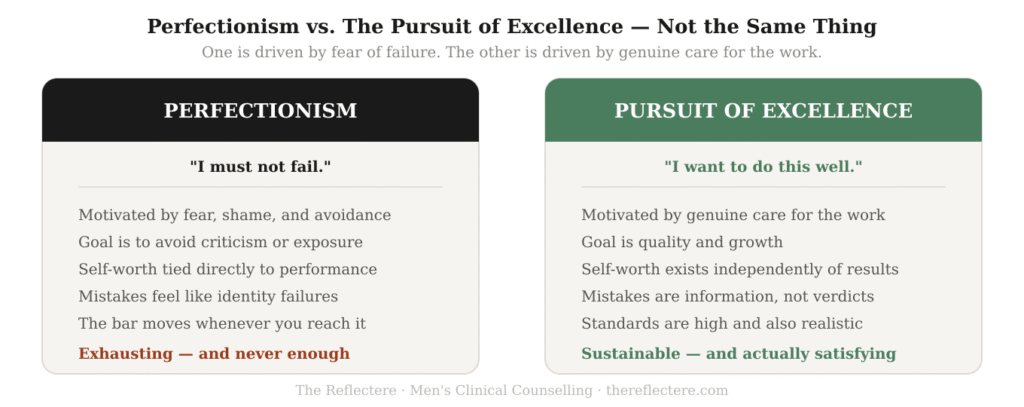
That’s not high standards. That’s perfectionism. And while the two can look identical from a distance, they are entirely different engines running entirely different kinds of lives.
What Perfectionism Actually Is
The word gets used loosely, often as a kind of self-deprecating compliment: “I’m a bit of a perfectionist, I suppose.” What’s usually meant is something like: I care about quality, I notice details, I hold myself accountable.
That’s not perfectionism. That’s conscientiousness, and it’s a valuable trait.
Perfectionism, in the clinical sense, is something more specific and more painful: it’s the condition in which your sense of worth is contingent on your performance. Where failure isn’t information — it’s a verdict. Where not achieving the standard doesn’t mean you need to try again; it means there’s something about you that, if seen clearly, would make you unacceptable.
The distinguishing feature isn’t the height of the standard. It’s what’s riding on it.
A man pursuing genuine excellence can fall short and stay intact. He’s disappointed, he examines what went wrong, he adjusts, he continues. His self doesn’t require the outcome to justify itself. The work matters because he cares about the work.
A man driven by perfectionism can’t do that. Falling short isn’t a piece of information about the work — it’s a piece of evidence about him. The failure and the self collapse into one thing, and what he’s left with is the old, familiar sensation: not good enough.
Where It Comes From
Perfectionism isn’t a personality type you’re born with. It’s learned, usually in environments that communicated — explicitly or implicitly — that conditional love was on offer. That love, approval, and belonging were available on the condition of performance.
For some men, this was overt: a father whose attention arrived only when results were good, who withdrew or criticised when they weren’t. The child learns quickly what earns belonging and what forfeits it, and begins organising his behaviour accordingly.
For others, it was subtler: a family system where emotions weren’t safe, where appearing capable and together was the implicit requirement for being acceptable. Where struggle was embarrassing, difficulty was weakness, and the cost of not having it handled was a loss of standing in the family.
In either case, what gets installed is the same core belief: who I am without achievement is not enough. And the response to that belief, in a capable child who learns quickly, is to achieve — and keep achieving — as a way of making the belief temporarily untrue.
It works, in the way that adaptations work. The man gets good at performing. He earns the approval he was looking for. He builds a life that looks, from the outside, like success. The problem is that the belief underneath it never gets examined. The achieving keeps it quiet but doesn’t change it. And so the standard has to keep rising, because the thing it’s protecting against — the fear of being found inadequate — never goes away.
How Perfectionism Shows Up in Men
In men, perfectionism tends to be particularly well-disguised because most of the ways it presents look like virtues.
The Overachiever
The man who works harder and longer than anyone around him, who holds himself and often his team to standards that other people find exhausting, who is the last to leave and the first to identify what’s not good enough. From the outside, this looks like drive. From the inside, it’s fear with a very productive face. The output is real. The satisfaction almost never arrives.
The Procrastinator
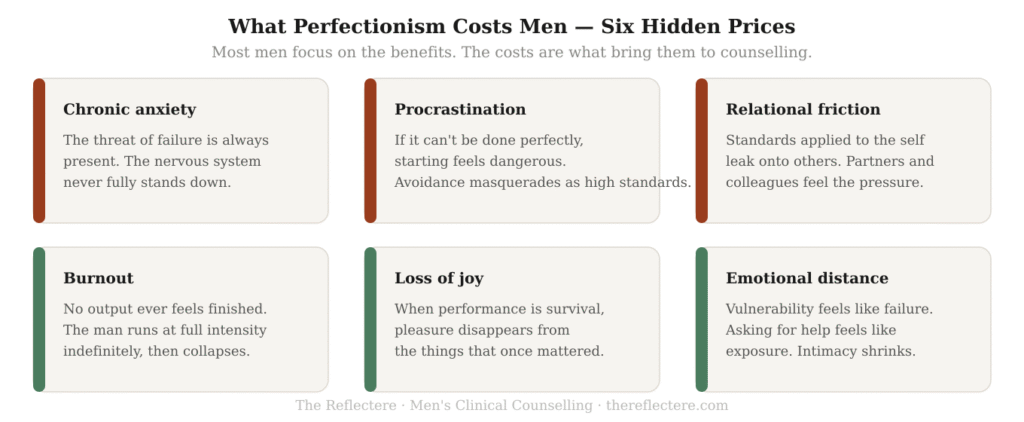
This one surprises people, because procrastination and perfectionism seem like opposites. But they’re close relatives. If the standard for starting is that the work will be done perfectly, and the emotional stakes of imperfect work are high enough, then not starting becomes a rational response to an irrational requirement. The man who can’t begin the project, the conversation, the difficult email — often isn’t lazy. He’s protecting himself from the possibility of finding out that his effort wasn’t enough.
The Critic
Some perfectionists apply their standards outward as much as inward. The partner who can’t load the dishwasher correctly. The colleague who never quite meets the bar. The man who finds himself frustrated, often, by the gap between how things are and how he would do them. The standards are real, but they’re also a projection — a way of managing the internal perfectionism by locating inadequacy in the environment rather than in the self.
The Man Who Can’t Rest
Relaxation requires the capacity to be unproductive without guilt. For a man whose self-worth is contingent on performance, genuine rest — not the brief collapse at the end of an exhausting week, but actual rest — feels either impossible or faintly shameful. Leisure becomes something he has to earn, and the bar for earning it keeps rising.
The Costs That Accumulate
Perfectionism can run for years before it produces a crisis visible enough to bring a man to counselling. But the costs accumulate in the background the whole time.
Chronic anxiety is almost universal. When the threat of failure is always present, the nervous system doesn’t fully deregulate. There’s a low-grade activation underneath ordinary days — scanning for what could go wrong, monitoring for criticism, anticipating the exposure that hasn’t happened yet.
Burnout arrives eventually, often suddenly. The man who has been running at full intensity, refusing to stop, unable to consider himself done — burns out in a way that genuinely surprises him, because the coping strategy that got him this far stops working without warning.
Relational damage is common and often invisible to the man until it’s pointed out. The standards a man applies to himself don’t stay contained there. Partners feel them. Children feel them. Colleagues feel them. The man isn’t trying to be critical — he’s applying the same pressure outward that he applies inward. But the effect on the people around him is real.
And perhaps the quietest cost is the loss of actual satisfaction. When performance is the condition of acceptability rather than an expression of care for the work, the work stops being enjoyable in any real way. The man who once loved his craft is just managing the standard now. The joy that was there at the beginning has been replaced by the relentless requirement to prove something that never stays proved.
What Working Through It Looks Like
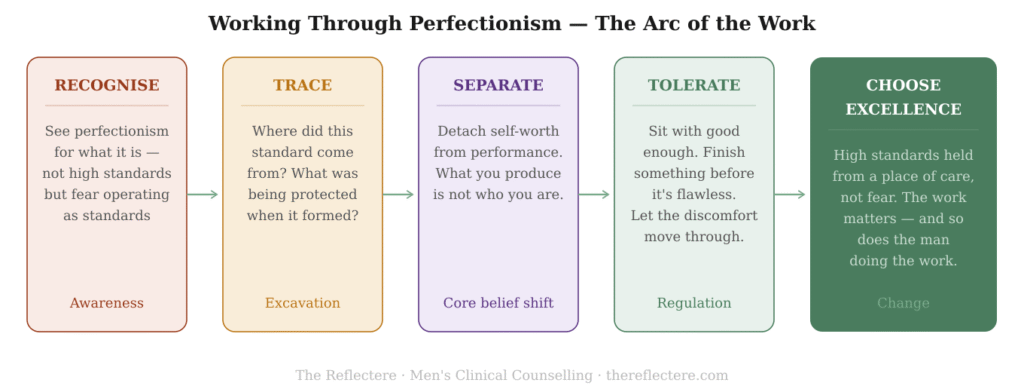
Recognising It for What It Is
The first step is simply naming what’s happening accurately. Most men with perfectionism don’t describe it as perfectionism — they describe it as caring about quality, taking their work seriously, holding themselves accountable. Those things are true. But they’re not the full picture.
Recognising perfectionism means being willing to look at the fear underneath the standard. What would happen if this wasn’t good enough? What does that mean about you? When the answer to that question is “something fundamental about my worth,” that’s the map of the problem.
Tracing Its Origins
Understanding where perfectionism came from changes the relationship with it. When a man can see that his standards weren’t formed in a vacuum — that they were a child’s intelligent response to an environment in which performance was the condition of belonging — he can begin to separate himself from the belief that drove them.
IFS is particularly useful at this stage. Working with the perfectionist part — understanding what it was trying to protect, what it believed would happen if it relaxed — allows a man to relate to it with curiosity rather than being controlled by it.
Separating Self-Worth From Performance
This is the core shift, and it doesn’t happen quickly. The belief that self-worth is contingent on performance is usually pre-rational — it was installed before the man had the cognitive capacity to examine it — and it doesn’t yield to logical argument.
What changes it is a different kind of experience: coming through failure intact. Not performing perfectly and surviving. Showing up imperfectly in a relationship and finding that the relationship holds. These experiences, accumulated over time in the context of a safe therapeutic relationship, begin to build an identity that doesn’t depend on the next achievement to justify itself.
Tolerating Good Enough
There’s practical behavioural work involved as well. Learning to finish something before it’s perfect. To send the email before it’s been revised four times. To rest before it’s been earned. These small tolerations of incompleteness are uncomfortable in a way that is itself informative — the discomfort reveals the belief, and surviving the discomfort begins to revise it.
Choosing Excellence on Its Own Terms
The goal isn’t to stop caring about quality. It’s to care about quality from a different place — not from the fear of what failure says about you, but from genuine investment in the work itself. The man who holds high standards because he cares deeply about what he’s building is not the same as the man who holds high standards to protect himself from exposure, even when the standards look identical from the outside.
That distinction — between excellence chosen and perfectionism driven — is one of the most significant shifts a man can make. Because the first one is sustainable. And the second one, eventually, isn’t.
Book your free 20-minute consultation here →
FAQ — Perfectionism Counselling for Men
What is perfectionism and how is it different from having high standards? High standards are about the quality of your work. Perfectionism is about what the quality of your work says about who you are. A man with high standards can fall short and remain intact — he’s disappointed, he learns, he continues. A man driven by perfectionism can’t do that cleanly, because falling short isn’t a setback in the work; it feels like evidence of something inadequate about him. The distinguishing feature isn’t the height of the standard — it’s what’s riding on it. When self-worth is contingent on performance, that’s perfectionism. When it isn’t, that’s the pursuit of excellence.
What causes perfectionism in men? Perfectionism is almost always learned in early environments where love, approval, or belonging were implicitly or explicitly conditional on performance. The child who discovers that doing well earns warmth and falling short earns withdrawal or criticism learns to organise his behaviour around achievement. The adult version of that child is the man who can’t stop achieving — not because the external consequences are still there, but because the internal belief that formed in response to them never got examined or revised.
How does perfectionism cause anxiety and burnout in men? Perfectionism keeps the nervous system in a low-grade state of threat because the possibility of failure — and its associated verdict on self-worth — is always present. That chronic activation is anxiety. Burnout follows because a man who cannot consider himself done, cannot rest before he’s earned it, and cannot tolerate a standard being met rather than exceeded, runs at full intensity without meaningful recovery until the system breaks. The collapse that follows often genuinely surprises him because the coping strategy that got him here stopped working without warning.
Can perfectionism cause problems in relationships? Yes, and this is one of the most significant and least-recognised costs. The standards a man applies to himself rarely stay contained. Partners and children feel them. Colleagues feel them. The man who holds himself to impossible standards often holds others to versions of the same, sometimes consciously but often without realising it. The relational friction this creates — partners who feel chronically not-quite-right, children who feel they can never satisfy him, colleagues who find him exhausting — tends to build quietly over years before it produces a visible crisis.
What does therapy for perfectionism look like at The Reflectere? Work with perfectionism draws on several modalities depending on where the man is. IFS is useful for working with the perfectionist part of the internal system — understanding what it was trying to protect and what it believes would happen if it relaxed. NARM addresses the developmental origins of contingent self-worth, tracing the perfectionism back to the relational environments in which it formed. Somatic work helps with the body-level activation that perfectionism maintains — the chronic tension, the inability to rest, the vigilance that doesn’t stand down. Across all of it, the ARC framework — Awareness, Regulation, Change — provides the structure through which a man moves from recognising the pattern to revising the belief underneath it.
Do you offer perfectionism counselling virtually for men in BC? Yes. The Reflectere offers virtual counselling for men dealing with perfectionism, high-functioning anxiety, burnout, and self-worth across British Columbia and parts of Canada. A free 20-minute consultation is available at thereflectere.janeapp.com.
The Reflectere offers in-person men’s counselling in Kelowna, BC and virtual counselling for men across British Columbia and Canada. Therapeutic approaches include IFS, Somatic Therapy, NARM, CBT, and DBT.