



Nervous system regulation refers to the capacity to manage physiological and emotional arousal — to move between states of activation and calm in response to what’s actually happening, rather than being stuck in chronic overdrive or shutdown. For men, building regulation capacity is foundational to emotional health, relationship stability, and lasting psychological change. It’s not about suppressing emotion or maintaining artificial calm — it’s about developing a nervous system that can feel fully, respond accurately, and recover efficiently from stress and difficulty.
Most men who come to counselling aren’t looking for regulation. They’re looking for answers.
They want to understand why they keep reacting the same way. Why they can’t slow down. Why the anger comes faster than they can track it. Why they go blank and cold in the moment they’re most needed. Why — even when they know exactly what they should do — something else takes over and does something different.
What they’re describing, usually without knowing it, is a dysregulated nervous system.
And what they need, before insight can produce real change, is regulation.
This post is about what nervous system regulation actually means for men — what it is, what it looks like when it’s missing, and how it’s built.
What the Nervous System Is Actually Doing
The autonomic nervous system is the part of the body that manages threat response — the system that decides, moment to moment, whether you are safe or in danger, and mobilises your body accordingly.
It operates largely outside conscious awareness. You don’t decide to tense your jaw when something threatens you. You don’t choose to go cold when a conversation gets too intimate. You don’t select anger as your response to feeling powerless. The nervous system makes those choices — based on a combination of what’s happening right now and the accumulated learning of every experience you’ve ever had.
This is important: the nervous system isn’t responding to reality. It’s responding to its interpretation of reality — filtered through everything it’s learned about what’s safe and what isn’t.
For a man whose nervous system learned its lessons in a genuinely difficult environment — an unpredictable home, a critical father, experiences of threat, chronic stress, trauma — that interpretation is often running on outdated information. Responding to the present as if the past is still happening.
The Window of Tolerance
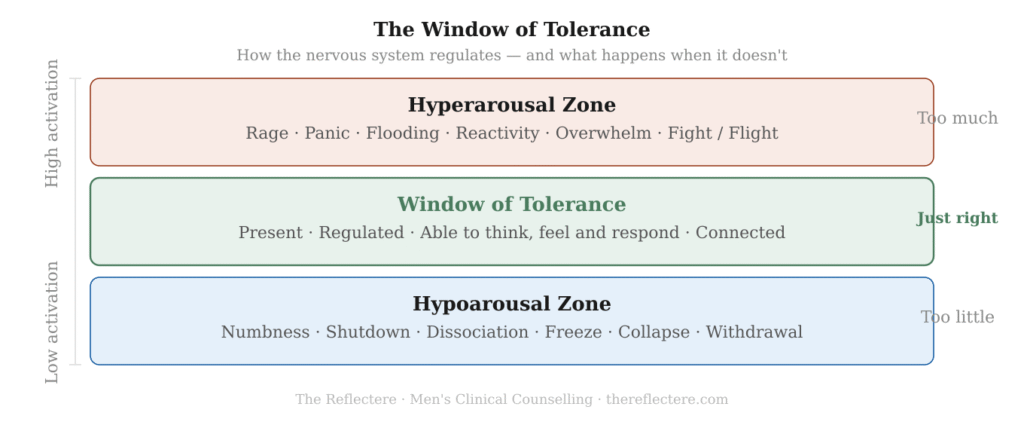
One of the most useful frameworks for understanding nervous system regulation is the window of tolerance — a concept developed by psychiatrist Daniel Siegel.
The window of tolerance describes the zone of nervous system activation within which a person can function effectively. Inside the window, a man can think and feel simultaneously. He can stay present in a difficult conversation. He can access his full range of response — empathy, logic, creativity, connection — rather than being driven by a single overwhelming state.
Outside the window, two things can happen:
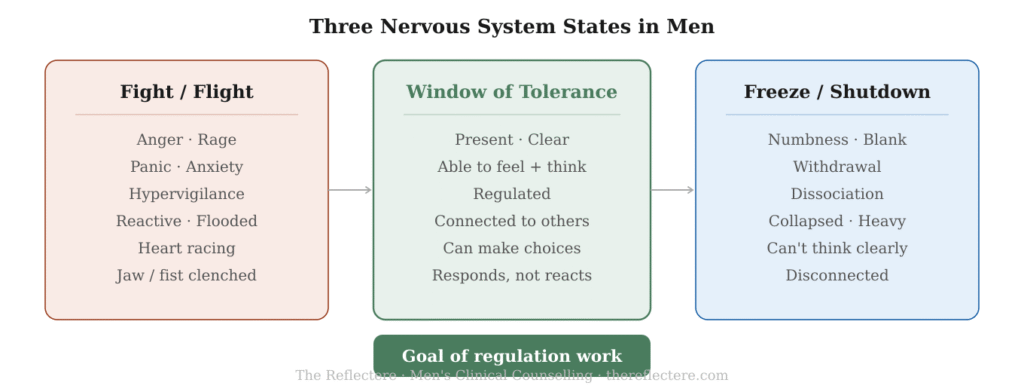
Hyperarousal — the nervous system goes too high. Anger, panic, flooding, reactivity. The man who explodes. Who can’t think clearly because the system has gone into full threat response. Who says things he doesn’t mean and can’t access his reasoning until the surge has passed.
Hypoarousal — the nervous system goes too low. Numbness, shutdown, dissociation, collapse. The man who goes blank. Who withdraws so completely he can’t be reached. Who is physically present but entirely absent. Who can’t feel anything in the moment when feeling is most needed.
Both states are protective responses — the nervous system doing what it learned to do. The problem isn’t that they happen. The problem is when they happen automatically, chronically, and in response to situations that don’t actually warrant that level of response.
Building regulation means building the capacity to stay inside the window — or to return to it more quickly when something pushes you out.
What Dysregulation Looks Like in Men
Most men don’t identify their experience as dysregulation. They identify it as how they are.
In the hyperarousal zone:
- Anger that arrives faster than they can track
- A hair-trigger that friends and family learn to navigate around
- Difficulty sleeping because the system won’t switch off
- Chronic tension in the jaw, neck, and shoulders that never fully releases
- Hypervigilance — always scanning, always braced
- Difficulty being fully present because the threat-detection system is constantly running
In the hypoarousal zone:
- Emotional numbness — knowing they should feel something and registering nothing
- Shutting down in conflict rather than staying present
- A pervasive flatness that sleep and rest don’t resolve
- Disconnection from the body — living from the neck up
- Going through the motions of a life without genuinely inhabiting it
Many men oscillate between both — flipping from explosive to shut-down, from intensity to numbness, without a stable middle. This oscillation is exhausting for the man himself and for the people closest to him.
Why Men Struggle With Regulation Specifically
Men don’t struggle with regulation because of any inherent physiological difference. They struggle because of how they were taught to manage their nervous systems.
The primary regulation strategy most men were given was suppression. When something activated the system — fear, sadness, vulnerability, need — the instruction, explicit or implicit, was to push it down. Hold it together. Don’t let it show.
Suppression works in the short term. It allows a man to function in situations where expressing emotional experience would be genuinely costly. But suppression is not regulation. It’s the lid on a pot — and what’s underneath keeps generating heat.
Over time, the effort of sustained suppression becomes its own source of physiological cost. The man who has been holding everything down for twenty years is carrying a significant load — one that doesn’t show on the surface but that absolutely shows in his reactivity, his exhaustion, and the gradual narrowing of his emotional range.
What Regulation Actually Is — And Isn’t
Regulation is not:
- Staying calm by suppressing what you feel
- Forcing yourself not to react
- Becoming passive or emotionally flat
- A technique you use to manage difficult moments
Regulation is:
- The capacity to feel what’s happening without being overwhelmed by it
- The ability to stay present in difficult conversations rather than flooding or shutting down
- A nervous system that can move between activation and rest fluidly
- The physiological foundation that makes everything else — insight, communication, change — actually possible
The distinction matters because most men approach emotional difficulty with a management mindset. They want to control the reaction. Regulation isn’t about control — it’s about capacity. A man who has developed genuine regulation capacity doesn’t suppress his anger — he can feel it, understand what it’s communicating, and choose what to do with it. He doesn’t shut down his fear — he can stay present with it long enough to respond rather than react.
How Regulation Is Built
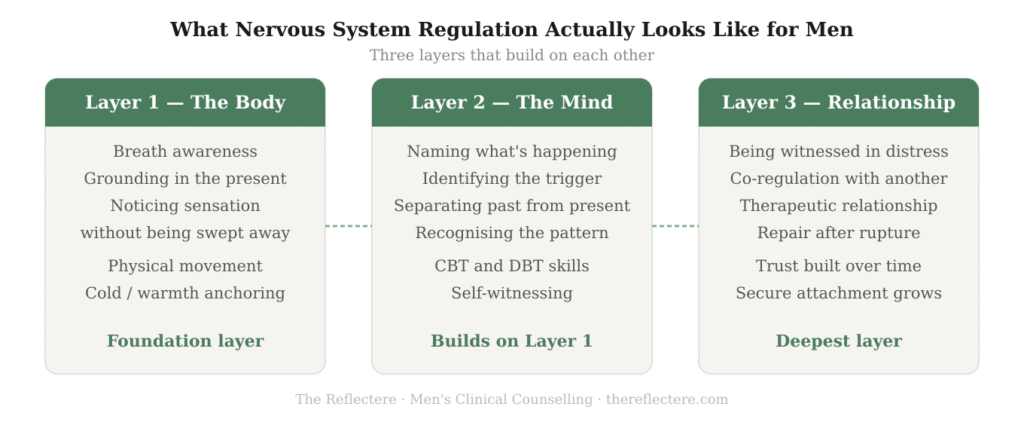
Regulation isn’t built through willpower or understanding. It’s built through repeated experience — in the body, in the mind, and in relationship.
Layer 1 — The Body
The nervous system is a physiological system. It changes through physiological experience, not through thinking about it.
The foundation of regulation work is developing awareness of the body — noticing physical sensation as it arises, learning to stay present with it rather than immediately overriding or escaping it. This is the work of somatic therapy: building the capacity to tolerate increasing levels of physiological arousal without the automatic shutdown or explosion response taking over.
Practical starting points include:
- Breath — slow, deliberate breathing directly activates the parasympathetic nervous system (the rest-and-digest counterpart to fight-or-flight)
- Grounding — physical contact with the present environment (feet on the floor, hands on a surface) interrupts threat-state activation
- Movement — physical activity discharges accumulated stress hormones and helps the system complete interrupted stress responses
These aren’t techniques to use in a crisis. They’re practices that, built into daily life, gradually expand the window of tolerance.
Layer 2 — The Mind
Once basic somatic regulation is developing, the cognitive layer becomes more accessible. This is where CBT and DBT skills come in — helping a man identify the automatic thoughts and interpretations that fuel dysregulation, and building the capacity to name what’s happening as it happens.
The ability to say — in the moment — “my system is activated right now” rather than being entirely inside the activation is itself a form of regulation. It creates a small but crucial space between the trigger and the response.
This layer also involves developing understanding of the pattern — what activates the system, what the activation is connected to historically, and what the response is actually protecting against. Understanding doesn’t produce regulation on its own. But it supports and deepens the physiological work.
Layer 3 — Relationship
The deepest and most powerful layer of regulation is relational. Human beings co-regulate — we help each other’s nervous systems settle through presence, attunement, and consistent connection. This is built into our biology from infancy.
The therapeutic relationship is one of the most significant mechanisms of nervous system change for exactly this reason. A consistent, attuned, reliable relational experience — with a therapist who shows up the same way week after week, who can stay present with what a man brings without flinching or withdrawing — provides the co-regulatory experience that helps the nervous system learn something different about what safety feels like.
This is why insight alone has a ceiling. Understanding your pattern doesn’t fully change the nervous system. Repeated relational experience of a different kind does.
What Changes When Regulation Develops
The changes that come with genuine nervous system regulation are concrete and specific.
A man’s window of tolerance expands. The things that used to push him over the edge start to stay inside it. He can stay in the hard conversation. He can feel the anger without it taking over. He can be with his partner’s distress without shutting down or escalating.
His relationship with himself changes. He can rest without guilt, because the system can actually rest. He can sit with uncertainty without needing to immediately resolve it. He can feel the texture of his own life — the good and the difficult — without either being overwhelmed or numbed out.
His relationships change. The people closest to him notice it — even before he does. The room is different when he enters it. The children notice. The partner notices. The man who used to make people manage around him becomes someone safe to be around.
That’s not a small thing. That’s the architecture of a fundamentally different life.
Book your free 20-minute consultation here →
FAQ — Nervous System Regulation for Men
What is nervous system regulation and why does it matter? Nervous system regulation is the capacity to manage physiological and emotional arousal — to stay within a functional range of activation, or return to it efficiently after being pushed out. For men, it’s foundational to emotional health, relationship stability, and lasting psychological change. Without adequate regulation capacity, insight and good intentions consistently run into the same ceiling — the nervous system overrides them before they can produce different behaviour.
What is the window of tolerance? The window of tolerance is the range of nervous system activation within which a person can function effectively — thinking and feeling simultaneously, staying present, accessing their full response capacity. Below the window is hypoarousal: numbness, shutdown, dissociation. Above the window is hyperarousal: rage, panic, flooding, reactivity. Regulation work builds the capacity to stay within the window — or to return to it more quickly when pushed out.
Why do men struggle with emotional regulation? Men struggle with regulation primarily because the primary coping strategy most men were taught — suppression — is not the same as regulation. Suppression manages the expression of emotional experience without resolving the underlying physiological activation. Over time it accumulates a significant physiological cost and actually narrows the window of tolerance rather than expanding it.
How is nervous system regulation developed? Regulation develops through three interconnected layers: physiological work (somatic therapy, breath, grounding, movement), cognitive work (naming patterns, CBT and DBT skills, self-witnessing), and relational work (co-regulation, the therapeutic relationship, secure attachment built over time). Each layer builds on the previous one, and all three are more effective together than any single approach alone.
What is the difference between regulation and suppression? Suppression is using effort and control to prevent emotional experience from being expressed or felt. It reduces the visible signal without resolving the underlying activation. Regulation is the capacity to feel emotional experience fully — to stay present with it within a manageable range — without being overwhelmed by it or needing to shut it down. Suppression narrows the window of tolerance over time. Regulation expands it.
Is nervous system regulation therapy available for men virtually in BC? Yes. The Reflectere offers virtual counselling for men working on nervous system regulation anywhere in British Columbia and parts of Canada. Sessions draw on Somatic Therapy, IFS, NARM, CBT, and DBT. A free 20-minute consultation is available at thereflectere.janeapp.com.
The Reflectere offers in-person men’s counselling in Kelowna, BC and virtual counselling for men across British Columbia and Canada. Approaches include IFS, Somatic Therapy, NARM, CBT, and DBT.