


Men grieve differently from the way grief is typically described — and because of that, most men don’t recognize what they’re experiencing as grief at all. Instead of sadness and tears, grief in men more commonly surfaces as anger, withdrawal, compulsive busyness, numbness, or physical symptoms that seem unrelated to any particular loss. This isn’t because men don’t feel loss. It’s because most men were taught, early and clearly, that the expressions of grief that come most naturally are unacceptable — and so grief stays underground, often for years, running behaviour from underneath the surface without ever being named. Grief counselling for men focuses on creating the space and safety for grief to be recognised, expressed, and integrated — not performed, not rushed, not compared to anyone else’s.
What Is Grief? (And Why It’s Bigger Than Most Men Realise)
Grief is the natural response to loss. That much most people know.
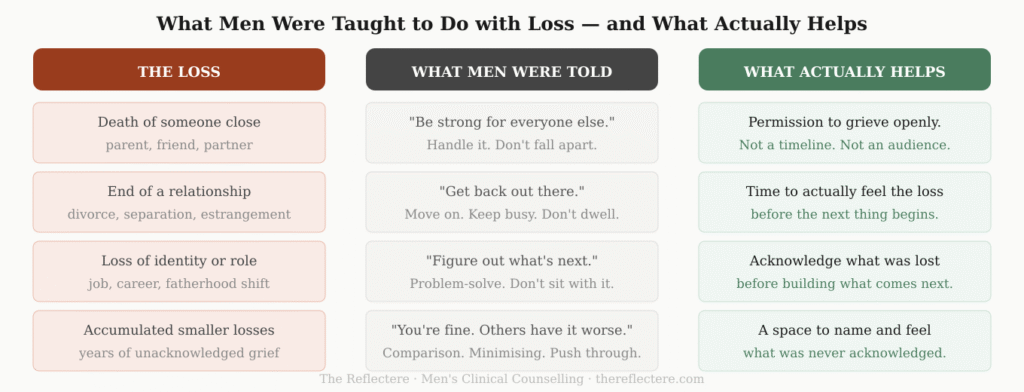
What’s less commonly understood is how wide the category of loss actually is. Death is the obvious one — the loss people are most likely to name and to receive some social acknowledgment for. But grief doesn’t limit itself to the loss of a person. Men carry unacknowledged grief for a great deal more than that.
The end of a marriage or long relationship. The loss of a career or professional identity that was central to how a man understood himself. The estrangement of a child or a parent. The death of a close friendship that simply faded. The gap between the life a man imagined he would have by this point and the life he’s actually living. The father who was absent in ways that were never spoken about. The version of himself he had to leave behind in order to survive a particular chapter.
These are real losses. They carry real weight. And most men receive almost no permission to grieve them — either from the culture around them or from the internal voice that absorbed that culture early.
The result is a backlog. Men who have never processed what they’ve lost tend to carry it, sometimes for decades, in ways that show up everywhere except in the place where grief belongs.
Why Men Don’t Recognize Grief as Grief
The question I hear fairly often, in some form, is: how would I not know I was grieving? It seems like the kind of thing you’d notice.
But grief in men is frequently invisible to the men carrying it, for two related reasons.
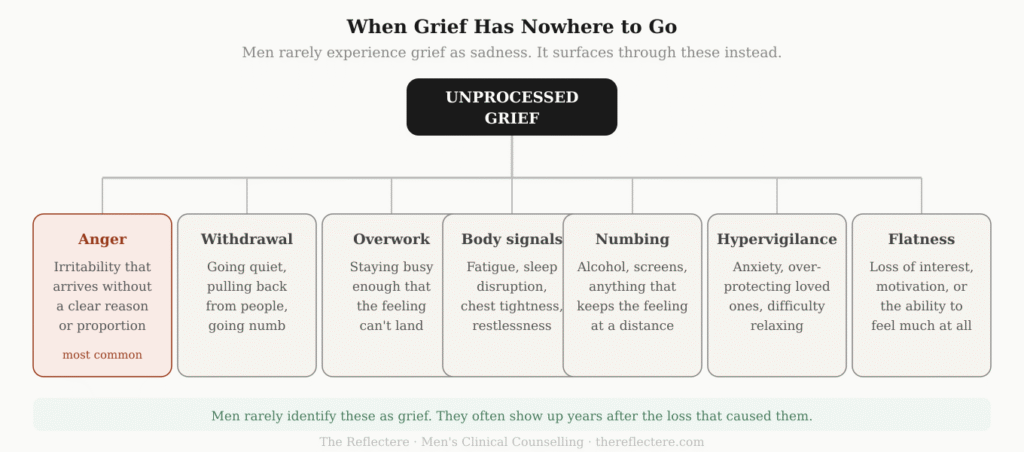
The first is that the presentation doesn’t match the template. Grief, as it’s most often depicted and discussed, looks like sadness — crying, withdrawing, being visibly affected. Many men don’t experience their grief this way, or at least not primarily. The grief in them surfaces as a short fuse, as a need to stay constantly busy, as flatness, as a vague restlessness that never quite settles. None of those things feel like grief from the inside. They feel like irritability, or stress, or just the way things are.
The second reason is that acknowledging loss requires sitting with something painful and uncertain, and most men were trained out of that early. Sitting with something uncertain and difficult was coded as weakness, or as self-indulgence, or as a failure to handle what life brings. The adaptive response — moving on, pushing through, keeping it together — became so automatic that it bypasses the feeling before it can be recognised.
The grief is there. It just never got a name.
How Grief Actually Shows Up in Men
Understanding how grief presents in men requires looking past the expected expressions toward what actually appears. These are the patterns that show up consistently:
Anger Without a Clear Source
The most common presentation of unprocessed grief in men is anger — not grief-flavoured sadness that tips into frustration, but genuine irritability and rage that seems disproportionate to its trigger. A man who snaps over small things, who carries a low background of resentment, who finds his temper shorter than it used to be — is often carrying grief that never got to be grief. The anger is real. But it’s doing a secondary job: keeping the softer, more vulnerable feeling at a distance.
Compulsive Busyness
The man who cannot stop. Who fills every available hour with work, with projects, with tasks, with anything that keeps forward momentum. This is a grief management strategy that gets rewarded by the culture, which makes it particularly hard to identify. The busyness isn’t incidental — it’s intentional at a level beneath conscious awareness. If I stop, I might feel it. So I don’t stop.
Withdrawal and Emotional Flatness
Some men go the opposite direction. They don’t get busier — they go quiet. They pull back from people, lose interest in things that used to matter, move through days with a kind of grey flatness that isn’t quite depression but isn’t all right either. This is what grief looks like when it’s been suppressed into numbness. The feeling couldn’t go out, so it turned off.
Physical Symptoms
Unprocessed grief doesn’t stay in the mind. It lives in the body — in sleep disruption, in a persistent tightness in the chest, in fatigue that doesn’t respond to rest, in the nervous system running at a level of activation that doesn’t have an obvious cause. Men often seek medical explanations for these symptoms and find nothing, because the origin isn’t physical in the conventional sense. It’s emotional material that the body is holding because it was never allowed anywhere else.
Numbing Through Substances or Behaviour
Alcohol, pornography, gambling, overworking, excessive training — these can all serve the function of making sure grief doesn’t land. Not in a dramatic, addictive way necessarily. Just in the way that having a drink at the end of the day becomes habitual, or the gym schedule becomes a little more rigid, or the work hours a little longer, in direct proportion to what’s being kept at bay.
Hypervigilance and Anxiety
Loss activates the nervous system. When a man has experienced significant loss — particularly early loss, or loss that felt sudden and outside his control — the system learns to stay alert. He may become overprotective of the people he loves. He may struggle to relax even when things are objectively fine. He may find himself scanning for the next thing that could go wrong, because the last time he wasn’t scanning, something did.
The Losses Men Are Least Likely to Grieve
There are particular kinds of loss that men are especially unlikely to name or be given space to grieve.
The loss of a father who was present but absent. The father who was physically there but emotionally unavailable — who never knew his son, who didn’t offer warmth or interest or the kind of attunement a child needs — leaves a loss that is particularly hard to grieve, because there’s no death, no clear event, nothing that the culture gives permission to mourn. And yet many men carry it their entire lives without ever naming it as a loss. They’re grieving a father they never really had.
The loss of a version of themselves. The boy who had to become hard in order to survive a particular environment. The young man who gave up an ambition, a relationship, a direction, because circumstances required it. The version of a man that could have existed if things had gone differently. These losses are real and they accumulate.
The relational losses men aren’t supposed to care about. Men’s friendships, in particular, are rarely given the same cultural weight as romantic relationships. When a close male friendship ends — through drift, through conflict, through one person moving away — there’s almost no social language for the grief of it. Men are expected to have acquaintances, not deep friendships, and so the loss of one is expected to be manageable in a way that it often isn’t.
What It Looks Like When Grief Actually Moves
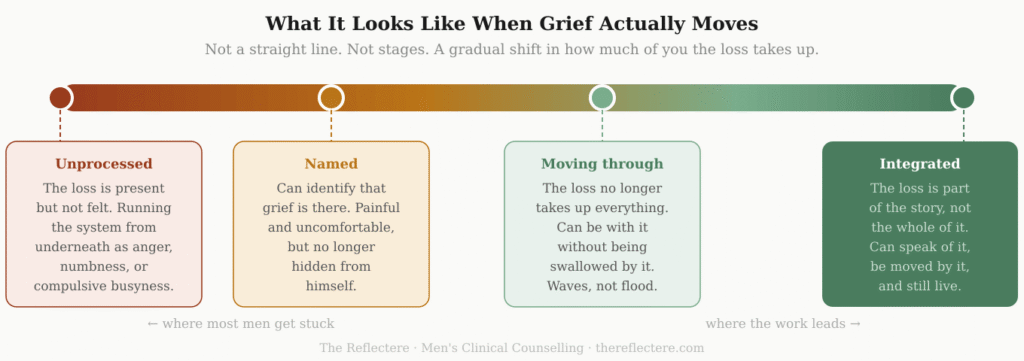
Grief doesn’t move through cleanly defined stages. It moves the way water moves — not in a straight line, not on a timeline, and not in the same way for every man or every loss. What changes isn’t the existence of the loss. It’s the relationship with it.
The goal of grief work isn’t to reach a point where the loss no longer affects you. It’s to reach a point where it’s part of your story without being the whole of it. Where you can speak about it, be moved by it when something brings it back, and still continue living fully. That’s what integration looks like.
Getting there requires, first, that grief be named. This sounds obvious but it isn’t. The man who has been carrying unacknowledged grief for years needs to be able to identify what he’s carrying — to say, with some precision, what was lost and that he is, in fact, still grieving it. That recognition alone changes something.
It then requires being allowed to feel it. Not performed. Not rushed. Not compared to what other people have been through. IFS is particularly useful here — working with the parts of a man’s internal system that have been protecting him from the grief, understanding what they were afraid would happen if it was felt, and gradually building enough safety for the feeling to actually be present.
Somatic work supports this process, because grief lives in the body. The tightness in the chest, the heaviness, the heaviness in the throat — these aren’t metaphors. They’re the physical experience of grief. Learning to tolerate that physical experience without immediately shutting it down is part of how the feeling finally moves.
NARM is useful when the grief is developmental — when it involves what a man needed and didn’t receive early in life, what he was forced to leave behind in order to adapt, what he never got to be. That kind of grief requires understanding where it came from and what survival strategies were built around the absence.
What most men discover, once grief is finally allowed to move, is that the flatness, the anger, the restlessness that had been present for years begins to shift. Not because the loss is erased. Because it’s finally been met.
Book your free 20-minute consultation here →
FAQ — Grief Counselling for Men
Why don’t men cry when they grieve? Men’s grief doesn’t always — or even usually — look like sadness and tears. Most men were taught, explicitly or through the texture of the environments they grew up in, that visible emotional expression was weakness, and that the appropriate response to loss was to handle it and move on. The grief doesn’t disappear because of this training. It surfaces instead through anger, withdrawal, compulsive busyness, physical symptoms, or emotional flatness — presentations that don’t look like grief from the outside and often aren’t recognised as grief by the man experiencing them.
What does unprocessed grief look like in men? Unprocessed grief in men commonly presents as persistent low-grade anger or irritability, difficulty relaxing or slowing down, emotional numbness or disconnection, physical symptoms without a clear medical cause (fatigue, sleep disruption, chest tightness), increased use of alcohol or other numbing behaviours, and a vague sense that something is wrong that can’t be clearly located. Because none of these presentations are immediately recognisable as grief, men often live with unprocessed loss for years without naming it.
Can grief cause anger and depression in men? Yes — both are common presentations of grief in men. Anger is one of the most frequent ways grief surfaces in men who have no other outlet for the feeling: the loss activates pain, the pain can’t go where it needs to go, and it converts to anger instead. Depression — particularly the kind characterised by flatness, withdrawal, and loss of interest rather than by visible sadness — is often unprocessed grief that has been suppressed over a long period. Treating the anger or the depression without addressing the underlying grief tends to produce limited results.
What kinds of loss do men grieve? Men grieve all the same losses as anyone — death of loved ones, end of relationships, loss of health. But there are categories of loss men are particularly unlikely to have permission to grieve: the loss of a father who was present but emotionally absent; the loss of career identity or professional role; the loss of close male friendships; the gap between the life a man imagined and the one he’s living; and what might be called developmental losses — the parts of himself he had to suppress or abandon in order to survive particular chapters of his life. These losses are real and they accumulate, often without being named.
What therapy helps men process grief? At The Reflectere, grief work draws on several approaches depending on the man and the loss. IFS is useful for working with the parts of the internal system that have been protecting a man from his grief — understanding what they were afraid would happen if the feeling was felt, and building enough safety for it to be present. Somatic Therapy addresses how grief is held in the body and builds the capacity to stay with the physical experience of it without shutting down. NARM is particularly useful for developmental grief — losses that go back to what a man needed and didn’t receive early in life. The ARC framework — Awareness, Regulation, Change — provides the broader structure: from naming what’s been carried, to tolerating the feeling, to integrating the loss into a life that keeps moving.
Do you offer grief counselling for men virtually in BC? Yes. The Reflectere offers virtual grief counselling for men across British Columbia and parts of Canada. Sessions are tailored to how men actually experience grief — practically, often without obvious emotional expression, and frequently after years of carrying something unacknowledged. A free 20-minute consultation is available at thereflectere.janeapp.com.
The Reflectere offers in-person men’s counselling in Kelowna, BC and virtual counselling for men across British Columbia and Canada. Therapeutic approaches include IFS, Somatic Therapy, NARM, CBT, and DBT.