




Vulnerability in men is not about disclosure for its own sake — it’s the capacity to be genuinely affected by experience and to allow another person to know what’s actually happening inside you. Most men weren’t taught this. They were taught its opposite: that being affected is weakness, that needing support is failure, that keeping yourself together is what men do. The cost of that teaching accumulates quietly — in chronic loneliness, in relationships that stay at the surface, in an emotional numbness that eventually reaches the parts of life a man actually wanted to feel. Men’s counselling for vulnerability focuses on understanding where the closure came from, what it’s still protecting, and how to build the capacity for genuine connection gradually and safely.
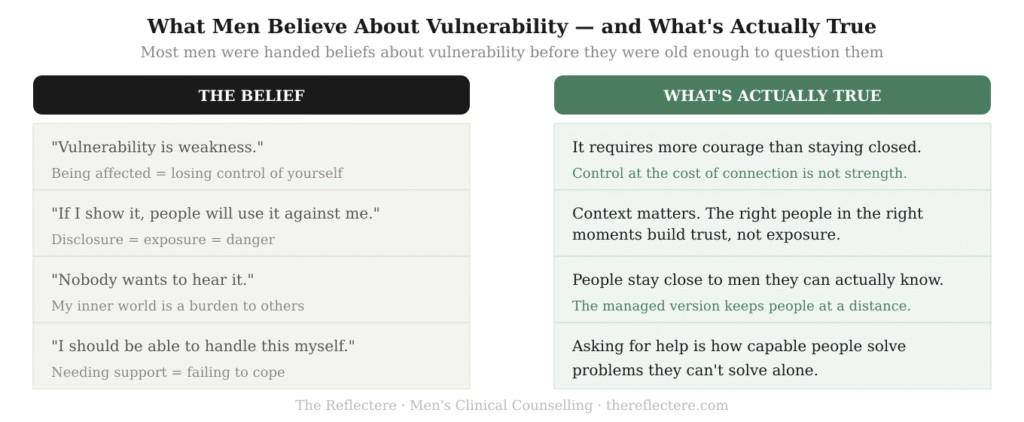
There’s a word most men brace for in counselling. Not because they don’t know what it means, but because of what they’ve been taught it means.
Vulnerability.
The response I see most often is something between discomfort and mild contempt. It sounds soft. It sounds like the kind of thing that belongs in certain conversations but not others, in certain kinds of men but not in the man sitting across from me, who has built a life, handled things, kept it together through circumstances that genuinely required keeping it together.
And I get that. I’m not here to argue with what a man learned. What I’m here to do is offer something more accurate — not because accuracy is an abstract virtue, but because the belief most men carry about vulnerability is actively costing them things they actually want.
What Vulnerability Actually Is
The word gets used imprecisely, which doesn’t help. In popular use it often means disclosure — telling people things, sharing feelings, being emotionally expressive. That framing puts a lot of men off, and understandably. That isn’t how most men are built, and more importantly, it isn’t actually what vulnerability is.
Vulnerability, in the sense that matters clinically, is something simpler and more fundamental: the capacity to be affected by your experience and to allow another person to know what’s happening inside you.
That’s it. It doesn’t mean falling apart. It doesn’t mean telling everyone everything. It doesn’t mean performing emotion. It means that something genuinely gets in — joy, grief, love, fear, disappointment, pride — and that you can let at least one person in your life see that it did.
Most men can do the first part without the second. They feel things — sometimes deeply. But the feeling and the disclosure are two different acts, and for most men, a lifetime of training has made the second one feel genuinely dangerous.
The belief underneath that training is usually some version of: if I show what’s actually happening in me, something bad will follow. I’ll lose standing. I’ll be seen as weak. The person I tell won’t handle it well, or will use it, or will think less of me for having needed to say it.
These beliefs aren’t irrational. For many men, they were formed in environments where that was true — where showing feeling did result in criticism or withdrawal or ridicule. The boy who learned to keep himself managed in order to stay safe was doing exactly what the situation required.
The man he became is still running the same programme. In a life that, by most measures, is no longer as unsafe as the one that taught him the lesson.
Where the Beliefs Come From
The messages that form a man’s beliefs about vulnerability arrive early and from multiple directions, and they don’t usually come as explicit instructions. They come as the texture of the environment.
The father who went quiet when things got difficult, who communicated through action and provision but never through disclosure. The peer group where staying composed was currency and any visible struggle was something to be covered quickly. The family system where emotion was either absent or unpredictable — where feeling too much led somewhere uncomfortable, and the sensible adaptation was to feel in private.
Some men received more overt messages. Don’t cry. Toughen up. Nobody wants to hear about that. These are cruder, but the effect is the same: certain inner experiences get sorted into the category of things that aren’t safe to bring outward. Eventually, they stop getting brought inward either. The shutdown extends from expression to awareness. A man who cannot show what he feels eventually stops knowing what he feels — not because the feelings aren’t there, but because he’s had decades of practice not attending to them.
This is a form of protection. It works, as protections go. The man doesn’t experience the specific pain of exposure and rejection. He experiences instead a different kind of pain — duller, harder to locate, and usually not named until something makes it unavoidable.
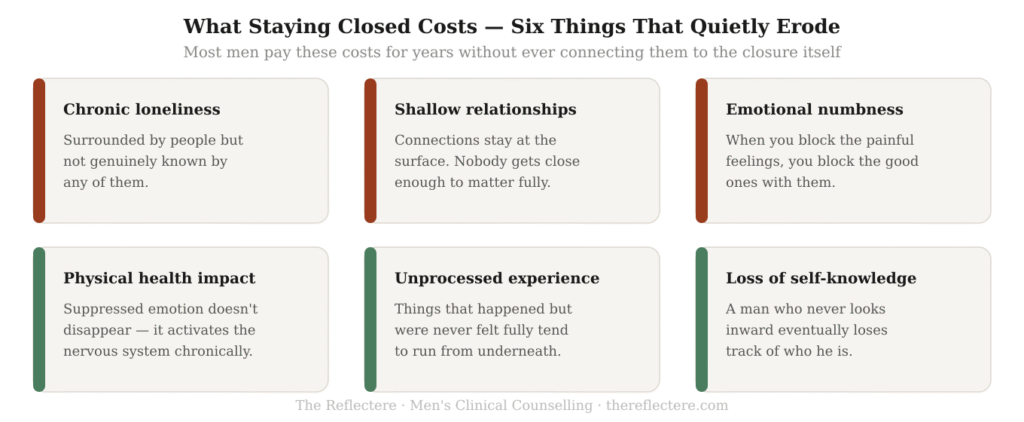
What Staying Closed Costs
The costs of emotional closure are real, and they tend to accumulate below the threshold of visibility until something creates a crisis clear enough to name.
Chronic loneliness is the most common. Not loneliness in the obvious sense — men with this experience are usually surrounded by people. But surrounded isn’t the same as known. A man who keeps himself managed is, by definition, keeping people at a distance from the real version of himself. The relationships are real. The connection stays shallow.
Relationships that thin over time. Early in relationships — partnerships, friendships — proximity does some of the work. But over time, sustained intimacy requires a kind of mutual knowing that can’t happen without at least some disclosure. Relationships that stay at the surface tend to drift apart slowly, or stay close in form only — a presence without genuine contact.
Emotional numbness. The shutdown that begins as selective — keeping particular feelings private — often broadens. When you spend long enough not feeling in public, you start not feeling in private. The capacity for joy, for genuine excitement, for the particular warmth of being moved by something — those go along with the grief and the fear that were the original targets of the shutdown. Men often describe this as feeling flat, disconnected from their own lives, present but not really present.
The body keeps the score. Suppressed emotion doesn’t simply dissolve. It stays in the nervous system as activation — as a background level of arousal that keeps the system working harder than it needs to. Over time this shows up as tension, as difficulty sleeping, as a body that’s always slightly on alert without a clear reason why.
Unprocessed experience. Things that happened but were never felt — losses, betrayals, failures, the accumulated weight of years of keeping it together — don’t go away when they’re not processed. They live in the system and run behaviour from underneath. The anger that arrives without a proportionate trigger. The aversion to certain situations that a man can’t fully explain. The sense that something is unresolved without being able to say what.
What Vulnerability Actually Looks Like for Men
This is worth being clear about, because the way vulnerability is sometimes described doesn’t fit how it actually develops in men, and the mismatch puts men off before they’ve had a chance to experience what it genuinely offers.
Vulnerability for men doesn’t usually start as dramatic disclosure. It starts as small tolerations of being real.
Saying something honest when the easy thing would be to say you’re fine. Staying in a conversation that’s become uncomfortable rather than changing the subject or going quiet. Letting someone see that something mattered to you, instead of managing the response to look more composed. Asking for help when you need it, rather than figuring it out alone because asking feels like a loss.
None of these things are monumental. All of them are uncomfortable for a man who has spent years in the opposite direction. And all of them, practiced over time in relationships that are genuinely safe enough, begin to build something that can’t be built any other way: the experience of being actually known, and finding that the relationship holds.
That experience is the thing that revises the old belief. Not argument. Not reassurance. The lived experience of showing up honestly and surviving it — of being seen without the consequence that was anticipated. The nervous system learns from that. Slowly, and then in a way that starts to feel less costly.
How the Capacity Develops
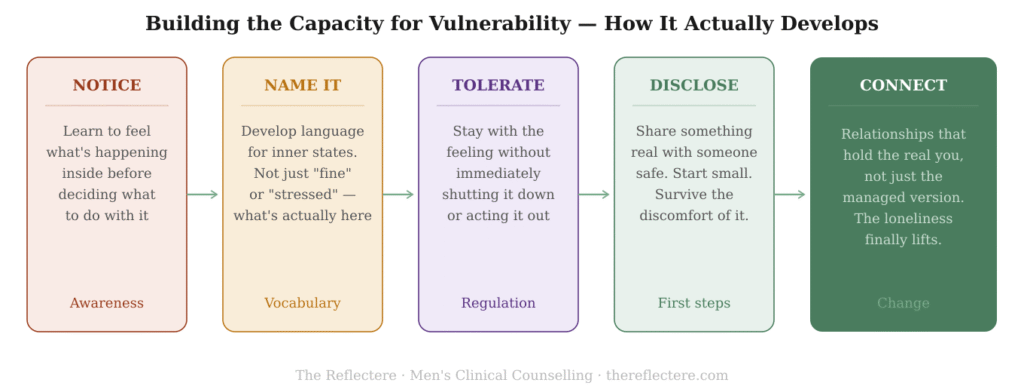
The work of building vulnerability as a capacity moves through recognisable phases, though the pace and shape are different for every man.
Notice
The starting place is awareness — learning to attend to what’s actually happening inside before deciding what to do with it. Most men who have been managing their inner world for a long time have lost some access to it. They know the downstream behaviour — the irritability, the withdrawal, the restlessness — but they’ve lost the thread back to the emotional state underneath it.
IFS is useful here. Working with the parts of a man’s internal system — understanding what they’re carrying, what they’re protecting, what they believed they were preventing by keeping things managed — gives him a way to become curious about his own inner life rather than just being run by it.
Name It
The next step is language. Many men have a limited vocabulary for emotional states — not because they’re emotionally illiterate, but because they’ve had less practice in that particular direction. Developing the capacity to say, with some precision, what’s actually present — not just “fine” or “stressed” or “good” but the more specific reality underneath — builds the bridge between the inner experience and any possibility of sharing it.
Tolerate
Learning to stay with difficult feelings without immediately acting on them or shutting them down is its own piece of work. Vulnerability requires the capacity to be affected without that affecting immediately becoming behaviour. To feel the discomfort of an honest moment without retreating into composure. Somatic work supports this — building the body’s capacity to hold emotional activation without the activation instantly driving action.
Disclose
The first moves toward genuine disclosure tend to be small and carefully chosen. A moment of honesty with a partner. Something said in a counselling session that had never been said out loud before. A conversation with a friend that went a level deeper than usual. These aren’t performances of vulnerability — they’re small genuine acts. And surviving them, finding that the sky doesn’t fall, begins to revise the belief that making them is dangerous.
Connect
What accumulates, over time, through the practice of noticing, naming, tolerating, and disclosing, is connection. Not closeness-adjacent things. Actual contact — the particular experience of being genuinely known by at least one person and finding that they stay. That’s what lifts the loneliness that most men have been carrying quietly for years.
That’s what vulnerability is for. Not self-improvement. Not becoming a different kind of man. The end of a particular kind of isolation that most men never find a name for until it’s already cost them a great deal.
Book your free 20-minute consultation here →
FAQ — Vulnerability and Men’s Counselling
What does vulnerability mean for men? Vulnerability for men means the capacity to be genuinely affected by experience and to allow at least one trusted person to know what’s actually happening inside. It doesn’t mean dramatic emotional disclosure, telling everyone everything, or performing feeling. It means that things get in — joy, grief, fear, disappointment, love — and that you can let someone see that they did. Most men were taught that this is weakness. Clinically, the opposite is closer to the truth: the capacity for vulnerability takes more courage than staying managed, and it’s the foundation of genuine connection rather than closeness-adjacent things.
Why do men struggle with vulnerability? Men struggle with vulnerability because most were trained, explicitly or implicitly, that showing what’s happening inside them comes with a cost — loss of standing, withdrawal of respect, the experience of being seen as weak. These beliefs were usually formed early, in family systems or peer environments where that was genuinely true, or where emotional expression was associated with something unpredictable or dangerous. The man who carries those beliefs into adulthood isn’t being irrational. He’s running a programme that once made sense. The problem is that it’s still running in a life where it often no longer applies, and the cost of it is real.
Is vulnerability a sign of weakness in men? No — though most men were taught that it was. The belief that vulnerability is weakness comes from conflating being affected with losing control, or conflating disclosure with losing standing. In practice, the capacity to be genuinely present with another person — to let them see what’s real rather than the managed version — requires more courage than the alternative. Keeping yourself closed is the easier option in the short term. The long-term costs of it — chronic loneliness, shallow relationships, emotional numbness, accumulated unprocessed experience — are what tend to bring men to counselling eventually.
What does vulnerability look like in practice for men? In practice, vulnerability for men rarely starts with major disclosures. It starts as small tolerations of honesty: saying something real when the easy thing would be to deflect, staying in a conversation that’s become uncomfortable, letting someone see that something actually mattered. Over time, in relationships that are safe enough to take small risks and survive them, these small acts accumulate. The man builds the lived experience of being seen and finding that the relationship holds — which is what revises the old belief that disclosure is dangerous. The arc is gradual and usually begins in one relationship, often a therapeutic one.
How does therapy help men with vulnerability? At The Reflectere, work with vulnerability draws on several modalities. IFS helps a man understand the parts of his system that have been managing his inner world — what they’re protecting, what they believe would happen if they relaxed, and where those beliefs came from. NARM addresses the developmental origins of emotional closure — the early relational experiences that taught a man that certain parts of himself weren’t safe to bring outward. Somatic Therapy builds the body’s capacity to tolerate emotional activation without immediately shutting down or acting out. The ARC framework — Awareness, Regulation, Change — provides the structure through which the work moves from noticing what’s actually inside, to staying with it, to gradually bringing it into relationship.
Do you offer counselling for men around vulnerability and emotional intimacy in BC? Yes. The Reflectere offers virtual counselling for men dealing with vulnerability, emotional closure, intimacy, and related patterns across British Columbia and parts of Canada. A free 20-minute consultation is available at thereflectere.janeapp.com.
The Reflectere offers in-person men’s counselling in Kelowna, BC and virtual counselling for men across British Columbia and Canada. Therapeutic approaches include IFS, Somatic Therapy, NARM, CBT, and DBT.