




A male identity crisis is not a dramatic breakdown or a sudden impulse to buy a sports car. It’s a gradual, often quiet process in which the identity a man has built — through his roles, his achievements, his relationships, and the values he inherited — stops feeling like a true reflection of who he actually is. It commonly occurs in midlife but can happen at any significant transition point. The experience is typically one of hollowness, restlessness, and a difficulty answering the question “what do I actually want?” It is not a sign of failure — it is often the first honest reckoning a man has had with himself in years.
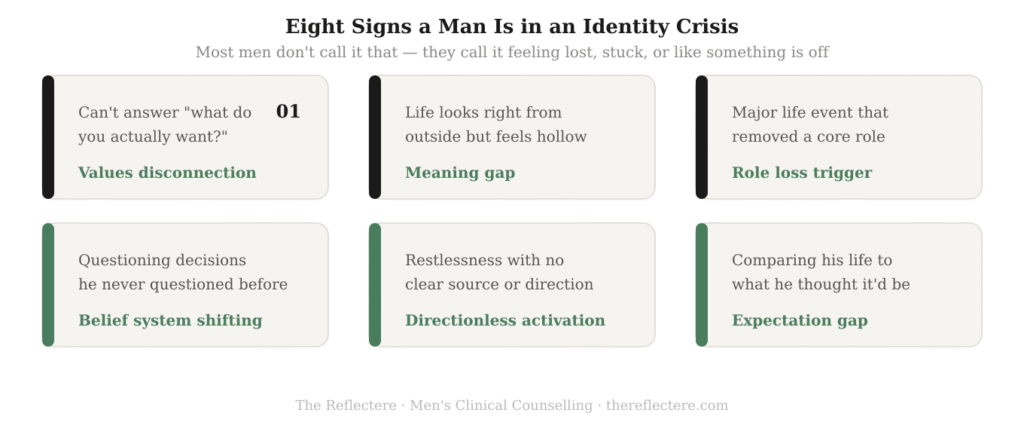
There’s a particular kind of conversation I have with men that starts the same way every time.
Everything is fine — objectively. The career is established. The family is there. The mortgage is being paid. There’s nothing obviously wrong. And yet something has gone quiet inside in a way that sleep doesn’t fix and weekends don’t touch. A sense of going through the motions of a life that looks right from the outside but doesn’t quite feel like his from the inside.
Most men don’t call this an identity crisis. That phrase carries a cultural weight — the cliché of the middle-aged man doing something reckless, trying to recapture something he’s lost. So they call it burnout, or stress, or just a rough patch that’ll pass.
Sometimes it does pass. But often what they’re describing is something more fundamental — a slow collision between the identity they built and the man who actually built it. Between who they became and who they might have been. Between the life they were supposed to want and whatever it is they actually want, which they may not have examined in a very long time.
That collision is worth paying attention to. Not because it signals failure, but because it’s often the beginning of the most important work a man can do.
What a Male Identity Crisis Actually Is
Identity, in a psychological sense, is the relatively stable set of answers a man holds to the question: who am I?
Those answers are constructed over time through roles, relationships, values, beliefs, and lived experience. A man knows who he is in part because he is a father, a husband, an engineer, a tradesman, a son. In part because he values certain things and stands for certain things. In part because he has a history — a story about where he came from and what it made him.
The problem is that most of these answers were assembled from the outside in. The roles were available. The values were inherited. The expectations were laid down by family, culture, gender, profession. A man builds an identity that works — that earns him belonging, respect, stability — without always examining whether it’s actually his.
An identity crisis is what happens when that construction starts to show its seams. When a role disappears, or a belief stops holding, or a man simply reaches a point of sufficient self-awareness to notice the gap between who he’s been performing and who he might actually be.
What Triggers It
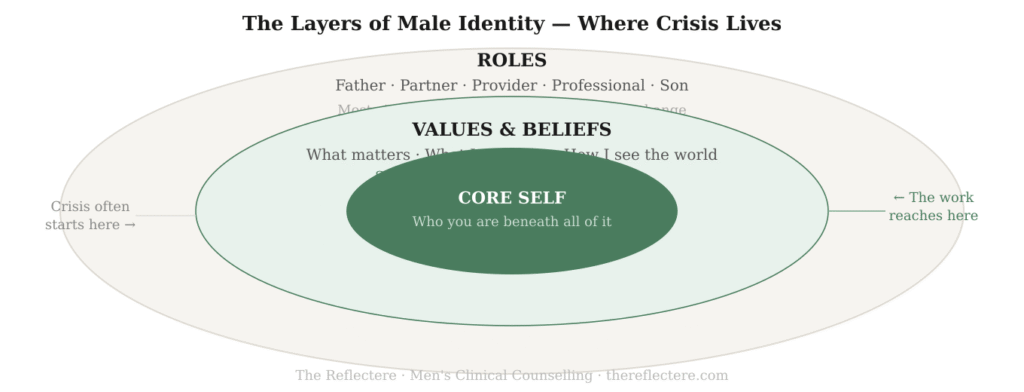
Identity crises in men are rarely random. They’re usually triggered by something — or a combination of things — that disrupts the structure a man has been relying on.
Role Loss or Transition
Men anchor their identity heavily in roles. When a major role changes or disappears — a career ends, a marriage dissolves, children leave home, a parent dies — the identity scaffolding built around that role can come down with it. The man who defined himself primarily as a provider, or a husband, or a professional, suddenly finds himself without the main structure through which he understood himself.
This isn’t weakness. It’s the natural consequence of having built identity from the outside in — which is how most men were taught to do it.
Midlife and the Unlived Life
There’s something that happens for many men in their forties — a reckoning with time that hasn’t happened before. The horizon, which once felt limitless, starts to look finite. The paths not taken become more visible. The version of himself he was going to become someday starts to feel less like a future possibility and more like something that required a different set of choices along the way.
Psychologist Carl Jung called this the confrontation with the unlived life — the parts of the self that were set aside in order to construct the functional identity, now pressing for acknowledgement. It’s uncomfortable. It’s also, in many cases, the beginning of genuine psychological maturity.
Success That Feels Empty
Some identity crises don’t follow loss or transition — they follow achievement. The man who reaches the goal he spent fifteen years working toward and feels almost nothing when he gets there. The success is real. The feeling of arrival never comes.
This kind can be the most disorienting, because it dismantles the belief that got him through — that if he just built enough, achieved enough, accumulated enough, he would finally feel like it was worth it. When the achievement arrives and the feeling doesn’t, the whole framework starts to look different.
A Confrontation With Mortality
Illness — his own or someone close to him — has a way of reorganising a man’s internal landscape very quickly. The questions that were easy to defer in good health become harder to avoid. Is this the life I actually want? Have I said the things I wanted to say? Am I the man I intended to be?
These aren’t morbid questions. They’re the questions identity is built to answer. And for men who haven’t examined their identity in any real depth, a confrontation with mortality can be the first time those questions get asked seriously.
What It Feels Like From the Inside
The internal experience of a male identity crisis is rarely dramatic. It’s usually quieter and more persistent than that.
A flatness that sits underneath ordinary days. A restlessness that has no obvious object. A difficulty getting genuinely excited about things that used to matter. A sense of watching yourself go through the motions of your own life from a slight distance.
Some men describe it as feeling like they’re living someone else’s life — a life that was assembled according to the right specifications but doesn’t quite fit. Others describe a hunger they can’t name. A question that keeps surfacing without a clear answer: is this it?
The question isn’t pessimistic, even when it feels that way. It’s actually the most honest question a man can ask. It’s what happens when the constructed self starts to make room for the real one.
Why Men Avoid Looking at It Directly
The identity crisis is uncomfortable enough that most men find ways not to look at it directly.
Some intensify. They work harder, take bigger risks, push the life forward with more force — as if momentum will resolve what examination might clarify. Some escape. A new relationship, a new project, a new city, a new set of circumstances that defer the question without answering it. Some numb. Alcohol, screens, the background hum of busyness that keeps anything too close from landing.
None of these are character failures. They’re the predictable responses of a man who has spent his life building and is being asked, for the first time, to stop and look at what he built — and whether it’s actually what he wanted.
The deferral works, for a while. Then it stops working. And usually the crisis that arrives after years of avoidance is considerably more difficult to navigate than the one that was there at the beginning.
How Men Find Their Way Through
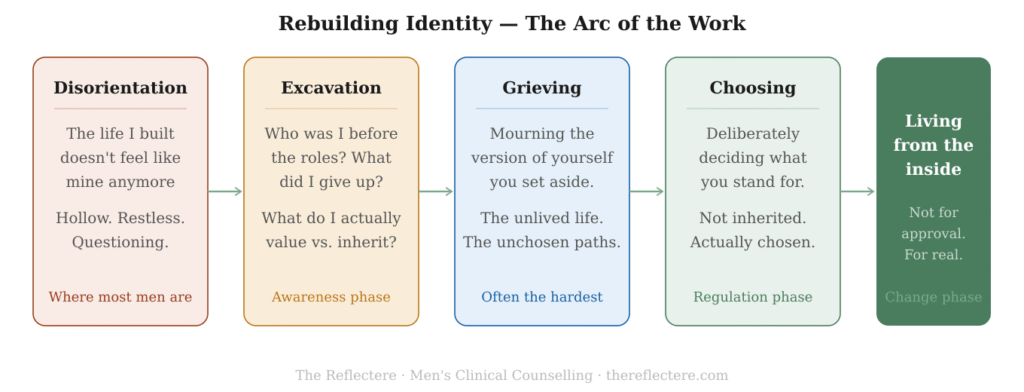
Working through an identity crisis isn’t about dismantling everything a man has built. It’s about examining it honestly — keeping what’s genuinely his and releasing what was never really his in the first place.
Getting Underneath the Roles
The first step is separating the man from the roles. Not in order to abandon them, but in order to understand which parts of his identity are genuine and which parts were constructed in service of belonging, approval, or survival.
IFS is particularly useful here — working with the parts of a man’s identity that formed to earn approval, manage anxiety, or protect him from exposure. Understanding what those parts are protecting, and whether that protection is still necessary, creates the space in which a more authentic identity can be examined.
Grieving the Unlived Life
Part of genuine identity work is mourning. Mourning the versions of himself he set aside. The paths not taken. The things he wanted and didn’t let himself want. This isn’t self-pity — it’s honest acknowledgement of the cost of the life that was built, which is a prerequisite for building something more intentional going forward.
Men who try to skip this step tend to find the grief shows up sideways — as anger, as restlessness, as a persistent dissatisfaction that nothing seems to resolve.
Asking Different Questions
The identity crisis, at its core, is a question crisis. The questions a man has been living by — what should I achieve? What do people expect of me? How do I measure up? — stop producing useful answers. New questions are needed.
What do I actually value — not what was handed to me, but what I’ve tested and found to be true? What kind of man do I want to be — not as an aspiration, but as a daily practice? What would I do with this life if I weren’t doing it for anyone’s approval?
These questions don’t have quick answers. They’re the work of months and years, not a single session. But asking them honestly, with support, is what genuine identity rebuilding looks like.
Building From the Inside Out
The identity a man builds through this work is fundamentally different in character from the one he had before. It’s not assembled from available roles and inherited expectations. It’s chosen — deliberately, with awareness of what it’s based on and why.
This doesn’t mean a man abandons his responsibilities or his relationships. It means he shows up to them differently — from a more grounded, more genuine, more conscious place. Less performing, more present. Less proving, more living.
The man who has done this work is often quieter in some ways and more solid in others. He knows more clearly what he stands for. He’s less threatened by the things that used to threaten him. He has a relationship with himself that doesn’t depend on external confirmation to hold.
That’s not a minor thing. For most men, it’s the difference between a life that looks right and a life that actually is.
Book your free 20-minute consultation here →
FAQ — Identity Crisis Counselling for Men
What is an identity crisis in men? A male identity crisis is the experience of a significant gap between the identity a man has constructed — through roles, achievements, and inherited values — and a more authentic sense of who he actually is. It typically produces feelings of hollowness, restlessness, difficulty knowing what he wants, and a sense that the life he’s built doesn’t quite fit. It is not a sign of failure or instability — it is often the beginning of a man’s most honest and important self-examination.
What causes an identity crisis in men? Common triggers include significant role loss or transition (career change, divorce, children leaving home), midlife confrontation with time and unlived possibility, achievements that arrive without the expected feeling of fulfilment, and confrontations with mortality through illness or loss. Often it’s not a single event but a gradual accumulation of these experiences that brings the identity question to the surface.
Is a midlife crisis the same as an identity crisis? They’re related but not identical. A midlife crisis is a cultural term often associated with impulsive or dramatic behaviour — the sports car, the affair, the sudden career change. An identity crisis is a more accurate psychological description of what’s often underlying those behaviours: a genuine disruption in how a man understands himself and what he’s building his life around. The dramatic behaviours are usually attempts to escape or resolve the identity question rather than engage it directly.
How does therapy help men through an identity crisis? Therapy provides the structured space and skilled support in which the identity questions can be examined honestly rather than deferred. At The Reflectere, identity work draws on IFS to understand the internal parts that constructed the existing identity and what they’ve been protecting, NARM to address the developmental origins of how identity formed, and Somatic Therapy to work with how identity shifts are held in the body. The ARC framework — Awareness, Regulation, Change — provides the structure through which the work moves from confusion to clarity to genuine rebuilding.
How long does it take to work through an identity crisis? There is no fixed timeline. Some men experience significant clarity within a few months of beginning therapeutic work. For men whose identity was more rigidly constructed or whose crisis involves deeper relational or developmental roots, the process typically takes considerably longer. What most men find is that the work moves in phases — periods of significant movement followed by periods of consolidation — and that the quality of the identity being rebuilt is worth the time the rebuilding takes.
Is identity crisis counselling available for men virtually in BC? Yes. The Reflectere offers virtual counselling for men navigating identity questions anywhere in British Columbia and parts of Canada. Sessions draw on IFS, NARM, Somatic Therapy, CBT, and DBT. A free 20-minute consultation is available at thereflectere.janeapp.com.
The Reflectere offers in-person men’s counselling in Kelowna, BC and virtual counselling for men across British Columbia and Canada. Approaches include IFS, Somatic Therapy, NARM, CBT, and DBT.