



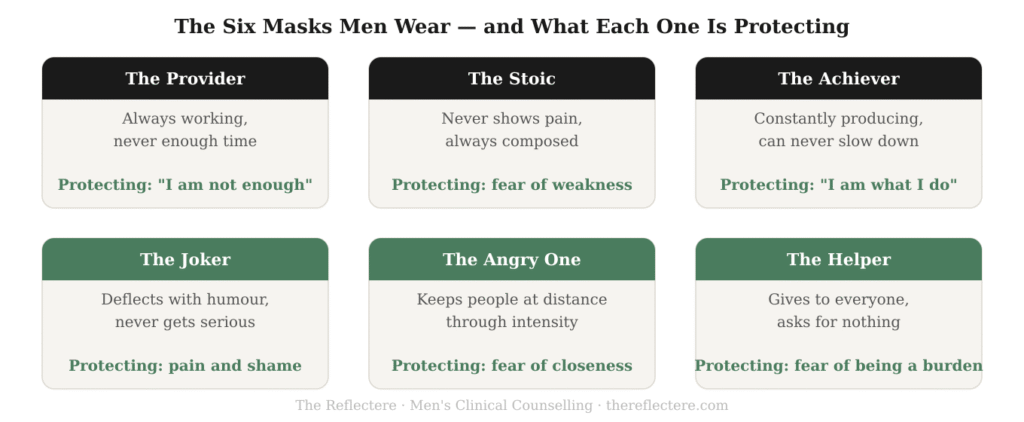
The masks men wear are protective identities — versions of themselves constructed early in life to manage difficult environments, earn approval, or avoid pain. The most common include the Provider, the Stoic, the Achiever, the Joker, the Angry One, and the Helper. Each mask protects something genuine and vulnerable underneath — shame, fear, grief, or unmet need. The mask isn’t the problem. The problem is when a man has worn it so long he’s lost access to who he is beneath it — and the cost of maintaining it begins to outweigh the protection it once offered.
Most men don’t know they’re wearing a mask.
That’s not a criticism. It’s just how it works. The mask goes on early — often before a boy has language for what’s happening — and by the time he’s a man, it’s been in place so long it doesn’t feel like a mask anymore. It just feels like who he is.
The capable one. The one who handles things. The one who doesn’t need much. The one who can always be counted on to deliver, to provide, to stay steady when everyone else is struggling.
These aren’t bad qualities. In many contexts they’re genuinely useful. But they become a problem when they’re the only thing available — when the man behind the mask has been so thoroughly hidden that he can’t find himself either.
This post is about the most common masks men wear, what each one is protecting, and what it costs a man to keep it on indefinitely.
Why Men Build Masks
Before naming the masks it’s worth understanding why they form in the first place — because a mask is never arbitrary. It’s always a response to something real.
Most masks develop in childhood or adolescence, in response to an environment that made certain expressions of selfhood unsafe. The boy who was shamed for crying built a mask of toughness. The boy whose worth was conditional on achievement built a mask of relentless productivity. The boy who grew up in an unpredictable or frightening home built whatever mask kept him safest in that specific environment.
The mask was intelligent. It was the best available adaptation to a situation that required one. A boy who built a mask did so because he needed to — because showing up as himself in that environment carried a cost he couldn’t afford.
The tragedy isn’t that the mask formed. The tragedy is that it often stays in place long after the environment that required it has changed. A man in his forties is still wearing the armour he built at nine — in a life that no longer requires it, at a cost he’s no longer willing to keep paying.
The Six Most Common Masks
The Provider
This man defines himself through what he provides — financially, practically, logistically. He is the one who keeps everything running. He works long hours, solves problems, and maintains the infrastructure of everyone around him.
The mask is built around a belief — often unexamined — that his value is contingent on his usefulness. That if he stopped providing, something essential about his place in his family or his own sense of himself would disappear.
Underneath: a fear that without the function, he is not enough. That he is valued for what he does rather than who he is. That if he ever stopped, the people he loves might not stay.
What it costs: his presence. He is everywhere and nowhere. The family is provided for and fatherless in the way that actually matters.
The Stoic
This man never shows pain. He handles difficulty without visible distress. He is the steady one — the rock, the anchor, the one who doesn’t crack under pressure.
The stoicism is real in some ways — he has developed genuine capacity to manage difficulty. But it’s also a performance, maintained at significant cost. He has learned so thoroughly to suppress emotional expression that the suppression has become his identity.
Underneath: a profound fear that showing vulnerability will be met with contempt, dismissal, or abandonment. Often rooted in a childhood where emotional expression was penalised, or a father who modelled stoicism as the only acceptable male response to difficulty.
What it costs: connection. The people who love him can’t reach him. They feel the distance even when they can’t name it. He feels it too.
The Achiever
This man is always producing. His calendar is full, his goals are clear, his track record is impressive. He is driven in ways that look like ambition and feel, from the inside, like something closer to compulsion.
The achievement is real — but it’s in service of something that achievement can never actually provide. Every finish line is followed immediately by the next one. The feeling the man is chasing never arrives because the underlying belief — that worth is earned through output — can’t be satisfied by output.
Underneath: a belief that he is only as valuable as his last performance. That rest is failure. That if he stopped producing, something about his fundamental worth would be exposed as insufficient.
What it costs: presence and health. Burnout, relational distance, and a life spent running toward a destination that keeps moving.
The Joker
This man deflects with humour. He is funny, quick, entertaining — the one who makes everyone laugh. He navigates difficult moments with a quip, an observation, a self-deprecating line that dissolves the tension before it becomes real.
The humour is often genuine. But it’s also a tool — deployed specifically at the moments when something real is about to surface. The Joker is very good at keeping things light. He is less good at staying in the room when things get heavy.
Underneath: pain and shame that have never been allowed to be taken seriously. Often a history of having difficult experiences minimised or dismissed, so he learned to do it himself before anyone else could.
What it costs: depth. His relationships stay at the surface. People enjoy him. Few people know him.
The Angry One
This man keeps people at a distance through intensity. His anger is real — but it’s also a force field. It controls proximity, manages vulnerability, and ensures that nobody gets close enough to see what the anger is protecting.
The anger is a secondary emotion — covering something more vulnerable underneath that feels too dangerous to expose directly. Shame, fear, grief — all of it routed through a channel that feels more powerful and less exposing than the original feeling.
Underneath: a deep fear of closeness and a deeper longing for it. Often a history where closeness produced pain — where the people he depended on were also the people who hurt him.
What it costs: the relationships he actually wants. The anger keeps people away — which is the point. Which is also the tragedy.
The Helper
This man gives to everyone and asks for nothing. He is the one who shows up, who supports, who is always available for others. He is genuinely generous — and he is also using that generosity to avoid being a burden, to earn his place, to make himself indispensable.
The helping is real. But it carries an invisible contract — if I give enough, I will be safe. If I need nothing, nobody can leave. If I make myself useful enough, I will finally deserve to be here.
Underneath: a fear of being a burden, of asking too much, of being the problem. Often rooted in a childhood where his needs were dismissed or where he learned early that other people’s needs took priority.
What it costs: his own needs, indefinitely unmet. And a growing resentment — quiet, rarely expressed — that the giving is never quite reciprocated in the way he needs.
What Every Mask Has in Common
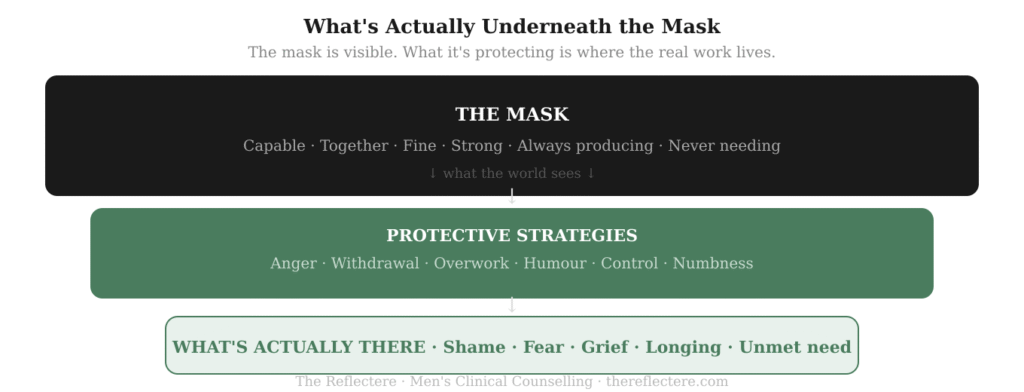
Different masks, same structure.
On the surface: a version of the man that the world sees and responds to. Capable, useful, functional, acceptable.
In the middle: the protective strategies that maintain the mask. Anger, humour, withdrawal, overwork, control, numbness.
At the core: what the mask is actually protecting. Shame. Fear. Grief. Longing. An unmet need that has been waiting, sometimes for decades, to be acknowledged.
The mask isn’t the enemy. It did something important. But the core — the thing it’s been protecting — needs attention that the mask prevents it from receiving. The strategy that once kept the wound safe is also what keeps it from healing.
The Cost of the Mask Over Time
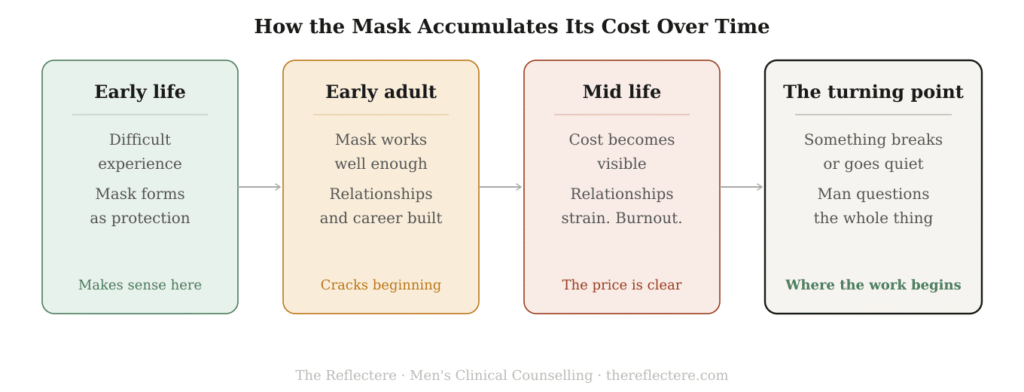
The cost accumulates slowly. Often invisibly.
In a man’s thirties it might be manageable. He’s productive, functional, successful by external measures. The cracks are there but containable.
By his forties, something shifts. The strategies that worked start to work less well. The exhaustion becomes harder to override. Relationships that seemed stable start to strain in ways that can’t be managed anymore. The mask gets heavier. The cost of maintaining it becomes more visible.
And often — a turning point. A relationship ends. A health scare. A business that collapses. A moment of standing in a life that looks right from the outside and feeling absolutely nothing on the inside.
That moment — as painful as it is — is often the most important one a man can have. Because it’s the moment the mask stops being invisible. And that’s when change becomes possible.
What Happens When the Mask Comes Off
Taking the mask off doesn’t happen all at once. It happens gradually — in the context of a therapeutic relationship that’s safe enough to be real in, slowly, at a pace the man himself determines.
What most men find underneath the mask is not the weakness or brokenness they feared. What they find is something they recognise — a version of themselves that’s been waiting quietly, sometimes for a very long time, to be allowed back in.
The tenderness they suppressed. The need they denied. The grief they never let themselves feel. The longing for genuine connection that the mask was keeping at arm’s length.
These aren’t weaknesses. They’re the parts of a man that make the rest of his life mean something.
The man who has done this work doesn’t become someone different. He becomes more fully himself — with access to a wider range of who he is, and a life that no longer requires constant performance to maintain.
Book your free 20-minute consultation here →
FAQ — Men’s Identity and Mask Work in Counselling
What does it mean when we say men wear masks? The masks men wear are protective identities — versions of themselves constructed in response to early environments where certain expressions of selfhood felt unsafe or were penalised. Common masks include the Provider, the Stoic, the Achiever, the Joker, the Angry One, and the Helper. Each mask was built for good reasons and has served real purposes — but over time, maintaining it carries a significant cost in terms of authentic connection, emotional health, and genuine self-knowledge.
How do I know if I’m wearing a mask? Common signs include: a persistent sense that the people around you don’t really know you; feeling like you’re performing a role rather than living a life; exhaustion that seems disproportionate to your circumstances; difficulty knowing what you actually want or feel independent of what you’re supposed to want or feel; a gap between how you present yourself and how you experience yourself privately.
Is wearing a mask the same as being fake or dishonest? No. Masks develop as genuine adaptations to real environments — they’re not chosen deceptions. A man who wears a mask isn’t being dishonest; he’s protecting something that needed protecting. The work of mask removal isn’t about exposing dishonesty — it’s about expanding access to parts of the self that have been hidden, often since childhood.
What is typically underneath a man’s mask? Most commonly: shame — a belief of fundamental inadequacy that the mask protects against exposure; fear — of rejection, abandonment, or what closeness might cost; grief — for losses, unmet needs, and versions of himself that had to be given up; and longing — for genuine connection, to be known, to be valued for who he is rather than what he provides.
Can therapy help a man take off his mask? Yes. Therapeutic work provides the relational safety and the structured support within which a man can gradually make contact with what’s underneath his protective identity. At The Reflectere, this work draws on IFS — which works directly with the protective parts of a man’s internal system and what they’re guarding — NARM, which addresses the early relational experience where the mask originally formed, and Somatic Therapy, which works with how the mask is held in the body.
Is this kind of counselling available virtually for men in BC? Yes. The Reflectere offers virtual counselling for men working on identity, authenticity, and the patterns underneath their protective masks, anywhere in British Columbia and parts of Canada. A free 20-minute consultation is available at thereflectere.janeapp.com.
The Reflectere offers in-person men’s counselling in Kelowna, BC and virtual counselling for men across British Columbia and Canada. Approaches include IFS, Somatic Therapy, NARM, CBT, and DBT.