



Men struggle with intimacy not because they don’t want it, but because of specific barriers developed through early experience and cultural conditioning — including learned associations between vulnerability and danger, limited emotional vocabulary, nervous system shutdown under relational pressure, and a tendency to confuse physical closeness with emotional closeness. Genuine intimacy — being fully known by another person and not found wanting — is both the thing most men want most and the thing they’re least equipped to create. It is, however, buildable. With the right support, men can and do develop the capacity for deep, sustained connection.
There’s a particular kind of loneliness that doesn’t make any external sense.
A man has a partner. He has friends, maybe children, colleagues he gets along with. His life, from the outside, is full of people. But underneath something persists — a sense of not being known. Of being present in every room and genuinely reaching no one. Of loving people and not being able to close the distance between the love he feels and the connection he actually experiences.
This isn’t an unusual experience. In fact, it’s one of the most common things men describe in counselling — often after years of assuming it was just how things were.
It isn’t just how things are. It’s the result of something specific. And it can change.
What Intimacy Actually Is
Before naming what gets in the way, it’s worth being clear about what intimacy actually means — because most men have a narrower definition than the one that actually matters.
Intimacy is not primarily physical. Physical closeness is one expression of it, but it’s possible to have significant physical closeness with another person and remain almost entirely unknown to them.
Intimacy, in the fullest sense, is the experience of being genuinely seen — with the doubt, the fear, the inadequacy, the need — and not found wanting. Of letting someone into the real version of your inner life, not the curated version. Of knowing that the connection between you is built on something real rather than on a performance you’re maintaining.
That’s a different ask from what most men have been trained to offer.
The Four Types of Intimacy
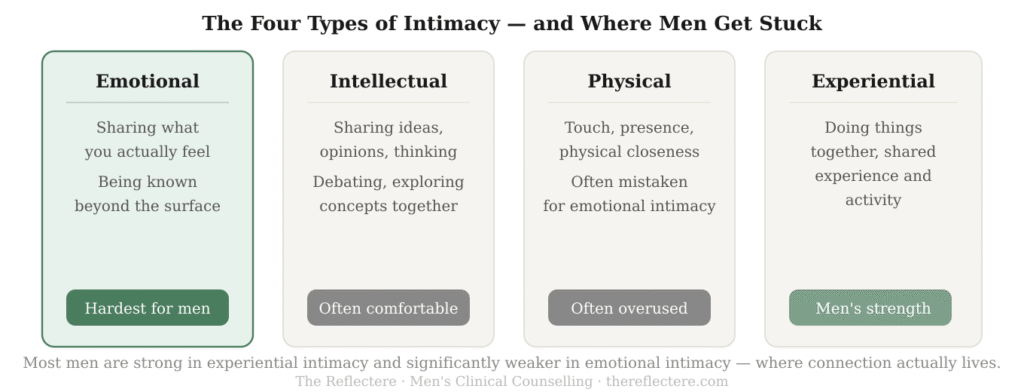
There are four distinct types of intimacy — and most men are significantly stronger in some than others.
Emotional intimacy — sharing what you actually feel. Being known beyond the surface. Allowing another person to see your inner experience — the fear underneath the confidence, the grief behind the anger, the longing inside the stoicism. This is the type most men find hardest, and the one where genuine connection most fundamentally lives.
Intellectual intimacy — sharing ideas, opinions, and ways of thinking. Exploring concepts together, debating, discovering how another mind works. Most men find this more accessible than emotional intimacy, and many men use intellectual connection as a substitute for the emotional kind — bonding through discussion while keeping the more vulnerable layer protected.
Physical intimacy — touch, presence, physical closeness. This is where many men are most comfortable, and where they most frequently seek and express connection. The problem is that physical intimacy without emotional intimacy produces a particular kind of hollow feeling — close in one dimension, distant in the one that actually produces the sense of being known.
Experiential intimacy — doing things together, building shared experience, activity alongside another person. This is often where men are strongest. Side by side in activity — on the tools, hiking, watching sport, working on something together — is where many men feel most genuinely connected. The challenge is that experiential intimacy rarely opens the door to the emotional kind on its own.
Most men are strong where intimacy requires least vulnerability, and weakest where it requires most. The result is a relational life that feels functional and frequently lonely at the same time.
Why Intimacy Is So Hard for Men
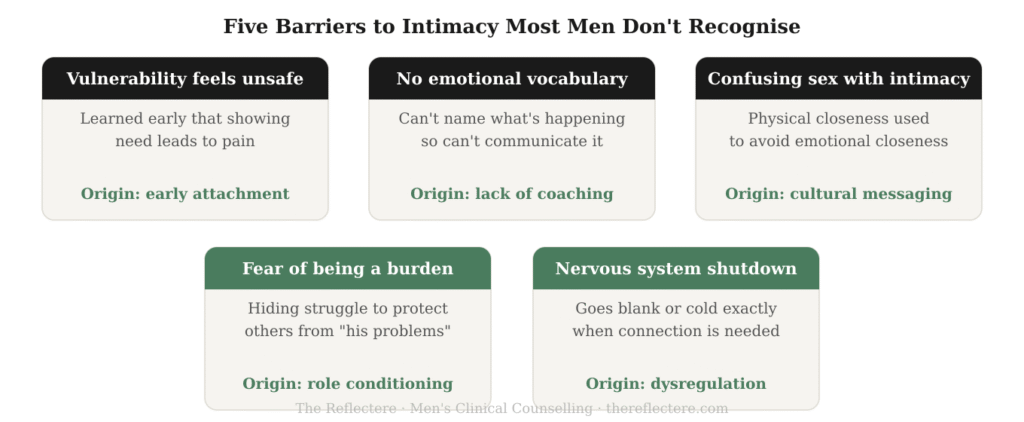
Vulnerability Was Made Dangerous
For most men, the association between vulnerability and danger was built early and reinforced consistently. The boy who showed too much emotion was corrected, ridiculed, or dismissed. He learned that openness — the prerequisite for genuine intimacy — produced pain rather than connection.
That learning travels directly into adult relationships. The closer someone gets, the more the old association activates. The nervous system doesn’t distinguish between the childhood environment where vulnerability was genuinely costly and the adult relationship where it might be the thing that saves it. It just registers: exposure = threat. And it does what it learned to do.
The Emotional Vocabulary Isn’t There
Intimacy requires language. Specifically, it requires the ability to name what’s happening in your inner world with enough precision that another person can actually understand it.
Most men were never taught this language. The emotional vocabulary available to the average man is limited — fine, stressed, angry, frustrated, tired. The actual landscape of emotional experience is considerably richer and more nuanced than that. Without the vocabulary, a man can’t communicate what he’s experiencing — not because nothing is happening, but because he doesn’t have the words for it.
His partner asks what’s wrong. He genuinely doesn’t know how to answer. She experiences this as withholding. He experiences it as failure. Both are frustrated. The distance grows.
Physical Closeness Gets Confused With Emotional Closeness
Many men have learned — through culture, through relationship pattern, through the path of least resistance — to seek emotional connection through physical means. Sex or physical touch becomes the primary mechanism for closeness, and when it works it works. But it leaves the emotional layer untouched.
The problem shows up in the gap that opens when the physical isn’t available — through conflict, distance, health, stress. The man whose primary intimacy mechanism is physical finds himself with no other way to close the distance. And his partner, who may be seeking emotional intimacy precisely when she is least available physically, finds the two of them at complete cross-purposes.
Fear of Being a Burden
Many men carry a deep, often unexamined belief that their inner world — their struggles, their fears, their needs — is too much. That sharing it will overwhelm, exhaust, or drive away the people they love. That the right thing to do is manage it privately, so it doesn’t become someone else’s problem.
This belief is often rooted in an early experience where emotional need was genuinely burdensome — a parent who was unavailable, overwhelmed, or explicitly communicated that the child’s needs were too much. It arrives in adult relationships as a man who manages his inner life in isolation while wondering why he feels so alone.
The Nervous System Shuts Down at the Worst Moment
For many men, the moments that most require emotional presence — conflict, a partner’s distress, a conversation about what’s not working — are precisely the moments when the nervous system goes offline.
Not through choice. Through activation. The emotional charge of the moment pushes the system out of the window of tolerance — into shutdown, numbness, or the kind of blank absence that partners experience as being abandoned in real time.
The man isn’t choosing to disconnect. His system is doing what it learned to do under threat. But the timing — going absent exactly when presence is most needed — is one of the most damaging patterns in intimate relationships.
What Genuine Intimacy Requires
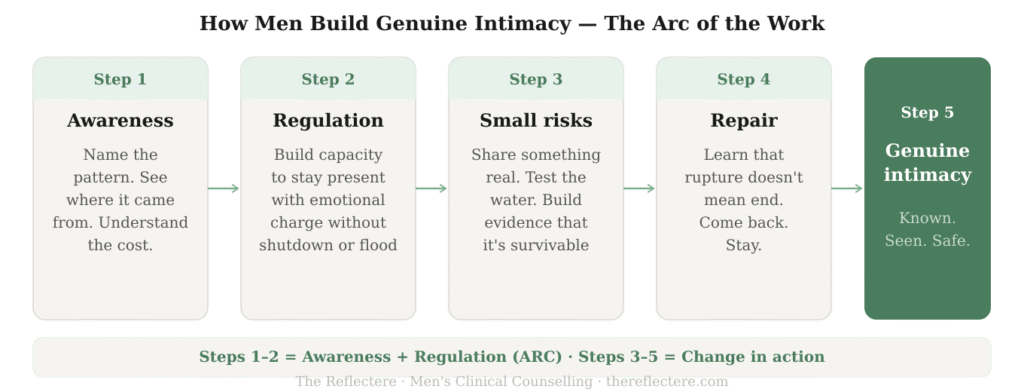
Building genuine intimacy isn’t about becoming someone who talks about feelings all the time. It’s about developing specific capacities that most men were never given the opportunity to build.
The Capacity to Stay Present Under Emotional Charge
The foundation of intimacy work for men is nervous system regulation — specifically, building the window of tolerance wide enough that emotional conversations don’t automatically trigger shutdown or escalation. This is somatic work, done gradually, in the body before it’s done in the relationship.
A man who can stay present in a hard conversation — who doesn’t go blank, who doesn’t explode, who can feel the activation without being overtaken by it — is a man who can do the rest of the work.
An Expanded Emotional Vocabulary
Developing the language to name inner experience is a learnable skill. It happens through practice, through slowing down enough to notice what’s actually present, and through having those observations reflected back in a way that helps them become more specific and more communicable.
This process often begins in therapy — where the questions asked, and the attention paid, gradually build a man’s capacity to describe his own inner world with more precision and more honesty than he’s been able to before.
Small, Graduated Risks
Intimacy doesn’t arrive fully formed. It’s built incrementally — through small acts of disclosure that carry just enough vulnerability to be real, offered into a relational context that’s safe enough to receive them.
A man who has never shared something real with his partner doesn’t leap from nothing to full emotional transparency. He takes one small step. He names one thing he’s actually feeling. He says one true sentence. And if that lands without catastrophe — if the world doesn’t end and the connection doesn’t break — he has evidence that the next step is survivable too.
Learning That Rupture Isn’t the End
One of the most significant barriers to intimacy for men is the belief — often unconscious, often rooted in early experience — that conflict or disconnection means the relationship is over. That if something breaks, it can’t be repaired.
This belief produces avoidance — of difficult conversations, of vulnerable moments, of anything that might risk the rupture. Which means the intimacy never deepens, because deepening always requires navigating some degree of difficulty.
Learning that rupture and repair are a normal, even necessary part of genuine connection — that two people can fall apart and come back, and the coming back actually deepens the bond — is one of the most important things a man can take from this work.
What Changes When Intimacy Develops
The changes that come with genuine intimacy development are specific and visible.
A man’s relationship with his partner changes. Not because there’s less conflict, but because the conflict becomes navigable. He can stay in the room. He can say what’s actually happening. He can hear what she’s saying without it becoming a threat.
His experience of himself changes. The loneliness that used to persist underneath everything begins to lift — not because he’s surrounded by more people, but because he’s actually reaching them.
His relationship with his own inner life changes. The parts of himself he’s been managing in isolation — the fear, the grief, the need — start to have somewhere to go. And that movement, quiet and gradual as it often is, changes the texture of daily life in ways that are hard to overstate.
A man who has learned to be genuinely intimate — with himself first, and then with the people he loves — is a man who is finally living in the life he built rather than performing it from a distance.
Book your free 20-minute consultation here →
FAQ — Intimacy Counselling for Men
Why do men struggle with emotional intimacy? Men struggle with emotional intimacy primarily because of three factors that frequently operate together: vulnerability was associated with danger through early experience, limiting emotional vocabulary means there’s no language available for inner experience, and nervous system patterns learned in difficult environments produce shutdown or escalation at exactly the moments when emotional presence is most needed. These are not character flaws — they’re learned patterns with identifiable origins that can be changed.
What is the difference between physical and emotional intimacy? Physical intimacy refers to closeness, touch, and sexual connection. Emotional intimacy refers to being genuinely known by another person — sharing your inner world, your fears, your genuine experience — and not being rejected for what’s found there. Physical intimacy can exist without emotional intimacy, and the absence of the emotional kind produces a particular kind of hollow feeling even in physically close relationships. Most men are stronger in physical intimacy and significantly weaker in emotional intimacy, which is where genuine connection actually lives.
Can men learn to be more emotionally intimate? Yes. Emotional intimacy capacity is not fixed — it’s a set of skills that can be developed with appropriate support. The key capacities are nervous system regulation (the ability to stay present under emotional charge), emotional vocabulary (the language to name inner experience), and the graduated willingness to take small relational risks. All of these develop over time through consistent therapeutic work.
How does therapy help men with intimacy issues? Therapy provides the specific conditions intimacy development requires: a safe relational environment in which small acts of disclosure can be practised, a skilled witness who can reflect and expand emotional experience, and the structured work of building nervous system regulation and emotional vocabulary. At The Reflectere, intimacy work draws on IFS to understand the internal parts that protect against closeness, NARM for the developmental origins of intimacy barriers, and Somatic Therapy to build the physiological capacity to stay present under emotional charge.
What is the ARC framework and how does it apply to intimacy? ARC — Awareness, Regulation, Change — is the framework that guides the work at The Reflectere. Applied to intimacy, it means: first developing awareness of the specific patterns and their origins (why closeness is hard and where that came from), then building regulation capacity (the nervous system ability to stay present under emotional charge), and finally the change phase — where new relational behaviour becomes possible, practised, and gradually more natural. Skipping regulation and going straight to change is the most common reason men’s attempts to improve intimacy don’t produce lasting results.
Is intimacy counselling for men available virtually in BC? Yes. The Reflectere offers virtual counselling for men working on intimacy and connection anywhere in British Columbia and parts of Canada. Sessions draw on IFS, NARM, Somatic Therapy, CBT, and DBT. A free 20-minute consultation is available at thereflectere.janeapp.com.
The Reflectere offers in-person men’s counselling in Kelowna, BC and virtual counselling for men across British Columbia and Canada. Approaches include IFS, Somatic Therapy, NARM, CBT, and DBT.