




Shame is the painful belief that there is something fundamentally wrong with who you are — not just what you did, but what you are. In men, shame is one of the most common emotional drivers behind anger, emotional shutdown, perfectionism, relational distance, and addictive behaviour, but it is rarely named as such because most men have never been taught to recognise it. Shame differs from guilt in a critical way: guilt says “I did something bad,” while shame says “I am bad.” Working through shame in men’s counselling involves learning to identify it, trace its origins, and build an identity no longer dependent on it for structure.
There’s an emotion that shows up in almost every therapeutic conversation I have with men, usually in the first few sessions, and almost never by its real name.
It comes in as anger. It comes in as the inability to ask for help. It comes in as the relentless drive to prove something that never quite feels proved, or the strange exhaustion of being someone who looks fine on the outside and feels like a fraud on the inside.
It takes different shapes in different men. But underneath most of those shapes, when you look carefully enough, is the same thing: shame.
Most men have never heard it described clearly. They know what it feels like — that hot, contracting sensation when they’ve failed at something, or when someone sees them in a way they didn’t want to be seen — but they don’t have a name for it, and they certainly don’t talk about it. Shame is the thing that makes you not want to talk about the thing.
Which is part of what makes it so powerful, and so worth understanding.
What Shame Actually Is
Shame and guilt are related but fundamentally different emotional experiences, and the distinction matters more than most people realise.
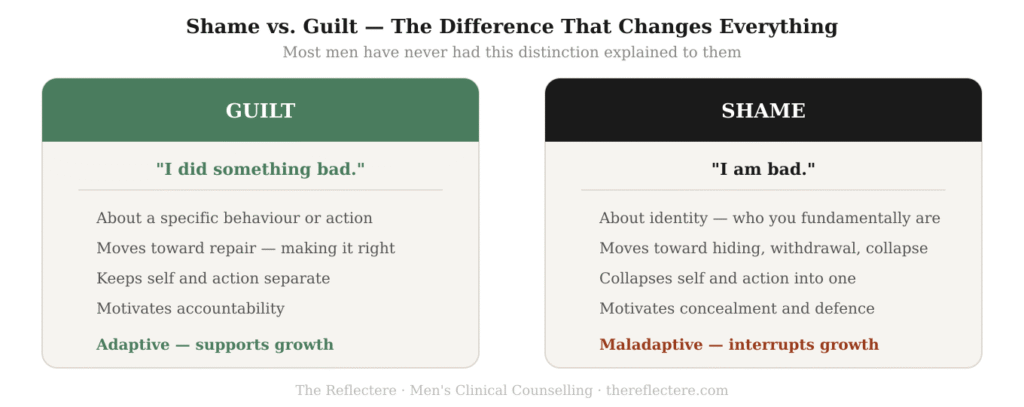
Guilt is the feeling that arises when you’ve done something that conflicts with your values. It’s behavioural — about a specific action — and it carries within it an implicit signal toward repair. You feel guilty, you acknowledge the harm, you try to make it right. Guilt, used well, is adaptive. It’s one of the mechanisms through which people stay in integrity with what they believe.
Shame is different. Shame isn’t about what you did — it’s about what you are. It’s not “I did something bad,” it’s “I am bad.” Not “I made a mistake,” but “I am a mistake.” The action and the self collapse into one thing, and what you’re left with is a fundamental belief about your own worth — or your lack of it.
That’s not a small distinction. Guilt moves toward accountability and repair. Shame moves toward concealment and defence. A man experiencing guilt will tend to want to fix the thing. A man experiencing shame will tend to want to hide, to escape, or to make sure no one else can see what he’s already convinced he is.
Where It Comes From
Shame doesn’t appear from nowhere. It’s learned, usually early, and usually from environments that communicated — directly or indirectly — that certain aspects of who you were were unacceptable.
For many men, the shame messages were about emotion itself. Boys who cried were weak. Boys who were scared were soft. Boys who needed comfort or reassurance were, in some families or cultures, treated as if those needs were embarrassing rather than ordinary. The message received wasn’t “your feelings are manageable” — it was “your feelings are a problem.” Over time, feeling becomes associated with failure, and failure becomes associated with a fundamental inadequacy.
Other shame messages are more specific. Around achievement — only succeeding justifies your existence. Around relationships — needing people is weakness. Around sexuality. Around body. Around how much space you take up, how much noise you make, how much help you ask for. The specific content varies, but the underlying architecture is consistent: there is something about you that, if seen clearly, would make you unworthy of belonging.
Men carry this into adulthood largely unexamined. And it runs a great deal of behaviour from underneath the surface.
How Shame Shows Up in Men
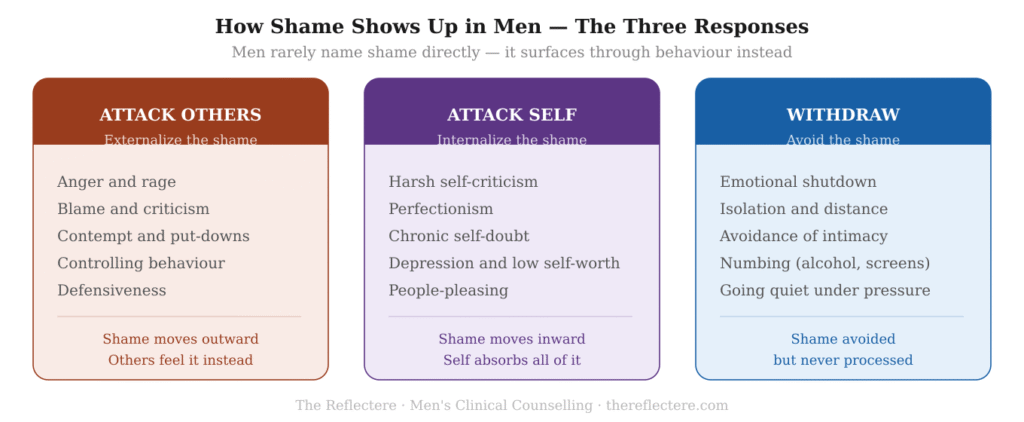
Shame rarely announces itself as shame. In men, it tends to surface through one of three behavioural responses, each of which has the function of managing the shame without ever looking at it directly.
Attacking Outward
The most common shame response in men is anger directed outward. When a man feels exposed — when something has happened that activates the deep belief that he is inadequate, incompetent, or less than — the fastest available defence is to direct that energy at someone else. The anger is real, but it’s serving a shame management function: if I can make this about your failing instead of mine, I don’t have to feel what I’d feel if I sat with it.
Blame, contempt, defensive rage, the partner who can’t do anything right, the colleague who’s always wrong — these patterns often have shame at their root. The man isn’t aware of this. He genuinely experiences the anger as justified by whatever the external trigger was. The shame underneath it is invisible to him precisely because the anger keeps him from having to feel it.
Attacking Inward
Some men do the opposite — they turn the shame entirely on themselves. This is the man who is his own harshest critic, who cannot accept a compliment without deflecting it, who holds himself to standards that move whenever he gets close to them, who privately suspects that if people could see what he was really like they’d leave.
Perfectionism, chronic self-doubt, depression, low self-worth, people-pleasing — these are often shame turned inward. The man has accepted the verdict that something about him is fundamentally inadequate and built his life around managing that verdict: performing well enough that nobody notices, or apologising constantly for the parts of himself he believes are too much.
Withdrawing
The third response is avoidance. The man who shuts down emotionally in conflict, who goes quiet when he feels exposed, who disappears into work or screens or alcohol when the shame starts to land — this is withdrawal as a shame management strategy. If I can become invisible enough, or numb enough, or busy enough, I don’t have to feel this.
Withdrawal is particularly painful in close relationships because it reads as indifference or rejection when it’s actually the opposite — it’s a man trying to protect the relationship from what he’s convinced his full presence would do to it.
The Connection to Other Presenting Issues
Understanding shame as an underlying driver changes how a lot of common presenting issues look.
The man who comes to counselling for anger management is often, underneath the anger, carrying significant shame around his own worth, competence, or adequacy. The anger is the symptom; the shame is what’s driving it.
The man presenting with relationship problems — difficulty with intimacy, emotional distance, pattern of pushing people away — is often organising his relational behaviour around the shameful belief that being truly known would result in rejection.
The man struggling with perfectionism or workaholism is often running from the same core belief: that if he stops achieving, whatever is underneath will be visible, and it won’t be enough.
Treating these issues at the surface — anger management techniques for the angry man, communication skills for the relationally distant one — can produce some change. But it’s working around the root rather than with it.
Why Men Struggle to Name It
Shame is self-concealing in a way that few other emotional experiences are. The very nature of shame — the belief that something about you is unacceptable — makes you want to hide it, which means it never gets examined, which means the belief never gets challenged.
There’s also a specific cultural layer for men. In many of the environments men were raised in, emotional vulnerability was itself a source of shame. Admitting you’re struggling is weak. Asking for help is failure. Not having it together is embarrassing.
Which creates a particularly painful loop: shame produces the need to hide, and hiding is itself something men have been taught to feel ashamed of needing to do. The emotional experience that most requires being witnessed is the one that most insistently resists it.
This is one of the reasons therapy with men often requires some patience at the beginning. Not because men don’t want to be helped, but because asking for help can itself activate the shame that brought them in.
What Working Through Shame Looks Like
The work of addressing shame in counselling isn’t about convincing a man that he’s fine. It’s not reassurance. Reassurance, applied to shame, rarely sticks — because the belief is pre-rational, and logical counter-arguments don’t reach pre-rational beliefs.
What it actually involves is something slower and more fundamental.
Learning to Name It
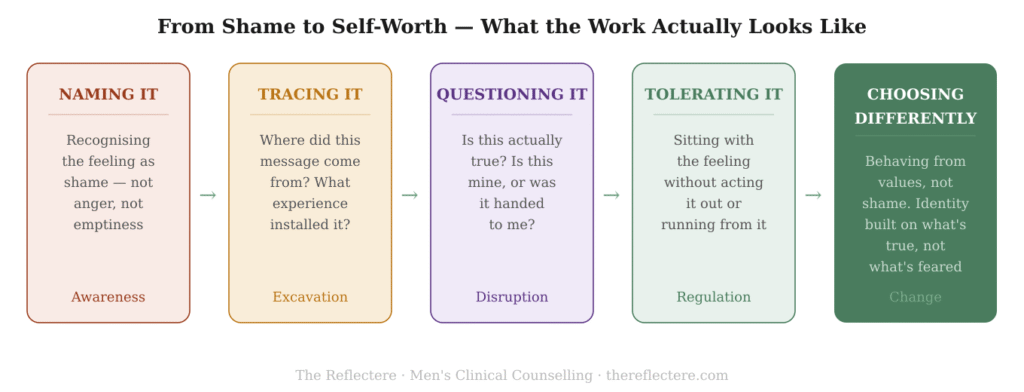
The first step is simply being able to identify when shame is present. Most men are so accustomed to the downstream behaviour — the anger, the withdrawal, the over-achieving — that they don’t recognise the emotional state underneath it. Part of early therapeutic work is developing enough vocabulary and self-awareness to notice: “this is shame, not just anger” or “this contraction I feel when I make a mistake — that’s shame.”
IFS is particularly useful here. Working with the parts of a man’s internal system that carry shame — understanding what they’re protecting, what they believe, where they came from — gives him a way to relate to the shame from a place of curiosity rather than being swallowed by it.
Tracing Its Origins
Once a man can name the feeling, the work moves to understanding where it came from. Shame that was installed by a critical father, or by a childhood environment where emotion wasn’t safe, or by repeated experiences of failure or rejection — that shame has a specific origin. It isn’t a verdict delivered by reality. It’s a conclusion a younger version of him drew from a particular set of experiences.
That matters because it means the conclusion can be examined. NARM is useful at this stage — working with the developmental origins of identity beliefs and understanding what survival strategies were built around them.
Tolerating It Without Acting It Out
Shame, like all strong emotional states, creates an urgent pressure to do something — attack, hide, escape. A significant part of the work is developing the capacity to feel the shame without immediately acting on it. To sit with the contracting, exposed feeling long enough to let it move through rather than driving behaviour.
This is somatic work as much as cognitive work. Shame lives in the body — in the chest, the gut, the impulse to make yourself smaller. Learning to tolerate it physically, to regulate the nervous system response it produces, is part of what changes the relationship with it over time.
Building Identity That Doesn’t Depend on Shame
The long arc of this work is toward an identity that isn’t organised around avoiding shame. Where a man knows who he is — what he values, what he stands for, what he brings — in a way that doesn’t depend on continuous external validation or the management of internal inadequacy.
That’s not a minor thing. For most men who carry significant shame, it’s the most important work they’ve ever done. Because so much of what felt like external problems — the anger, the relational distance, the exhaustion of performing — turns out to have been downstream of a single, very old belief about who they fundamentally are.
And that belief can change. Not quickly, and not without difficulty. But it changes.
Book your free 20-minute consultation here →
FAQ — Shame Counselling for Men
What is shame and why is it different from guilt? Guilt is the feeling that you did something wrong. Shame is the belief that you are something wrong. Guilt is behavioural — focused on a specific action — and tends to move toward repair and accountability. Shame is identity-based — it collapses the self and the action into one — and tends to move toward concealment, withdrawal, or defence. The distinction matters clinically because the two require different therapeutic responses. Reassurance and accountability work well for guilt; they’re largely ineffective for deep shame, which requires a more fundamental examination of the beliefs underlying it.
How does shame show up in men differently than in women? Research on shame and gender suggests men are most commonly shamed around failure, weakness, and inadequacy — particularly around the domains of achievement, competence, emotional control, and providing. This means shame in men often surfaces through anger, perfectionism, overachievement, and emotional shutdown rather than through the more commonly recognised presentations of shame — tearfulness, collapse, or explicit self-criticism. Because the presentation looks different, it’s often not recognised as shame by the man himself or by the people around him.
Can shame cause anger and relationship problems in men? Yes — this is one of the most clinically significant connections in men’s emotional health. Anger directed outward is one of the three primary shame responses, and it’s the most common in men. When a man’s sense of adequacy, competence, or worth is activated — by a perceived failure, a criticism, or a moment of feeling exposed — the fastest available defence is often anger directed at the external trigger. The anger is real, but it’s serving a shame management function. Addressing the anger without addressing the underlying shame tends to produce limited and short-lived change.
What therapeutic approaches help men work through shame? At The Reflectere, shame work draws on several modalities. IFS (Internal Family Systems) is particularly useful for working with the parts that carry shame — understanding what they’re protecting and what they believe. NARM (Neuroaffective Relational Model) addresses the developmental origins of shame-based identity, tracing it back to early experiences where certain aspects of self were learned to be hidden or denied. Somatic Therapy addresses how shame is held in the body and builds the capacity to tolerate shame without immediately acting it out. The ARC framework — Awareness, Regulation, Change — provides the broader structure through which the work moves from naming the experience to changing the identity beliefs built around it.
Is it normal for men to feel ashamed about being in therapy? Yes — and it’s worth naming directly. For many men, asking for help activates the same shame response that brought them to counselling in the first place. In environments where vulnerability was associated with weakness, seeking support can feel like an exposure of inadequacy rather than an act of courage. Part of the early work in counselling is often addressing this directly — not through reassurance, but by helping a man understand that the reluctance itself is worth examining, and that it makes complete sense given what he was taught.
Do you offer shame counselling virtually for men in BC? Yes. The Reflectere offers virtual counselling for men dealing with shame, self-worth, and identity across British Columbia and parts of Canada. All sessions draw on IFS, NARM, Somatic Therapy, CBT, and DBT, integrated within the ARC framework. A free 20-minute consultation is available at thereflectere.janeapp.com.
The Reflectere offers in-person men’s counselling in Kelowna, BC and virtual counselling for men across British Columbia and Canada. Therapeutic approaches include IFS, Somatic Therapy, NARM, CBT, and DBT.