




The need for control in men is rarely about the things being controlled. It is almost always a response to anxiety — specifically, to the experience of uncertainty feeling unsafe. When a man’s internal sense of security depends on outcomes being predictable, environments being manageable, and other people behaving in expected ways, the drive to control those things becomes a survival strategy rather than a personality preference. In men, this pattern often looks like competence, leadership, or high standards from the outside, which is why it frequently goes unaddressed. Men’s counselling for control issues focuses on understanding the anxiety underneath the behaviour and building a sense of safety that comes from the inside rather than from managing the world around you.
Most men who struggle with the need for control don’t recognise it as a problem. And honestly, from a certain angle, they’re right not to. The behaviours that come with it — planning thoroughly, holding high standards, staying on top of things, not leaving outcomes to chance — look like exactly the qualities that work and family and life tend to reward.
The man who checks the work twice. The one who plans the trip down to the detail. The one who’d rather carry the project himself than hand it to someone who might not do it the way it needs to be done. These aren’t obviously dysfunctional behaviours. They often produce real results.
The problem isn’t the behaviour. It’s what’s running underneath it.
Because when you get close enough to look — when the man gets close enough to look — what you usually find isn’t a preference for order or a commitment to quality. You find a quiet, constant dread of what happens when things go wrong. A nervous system that reads uncertainty as threat. A life organised, with enormous effort and real cost, around keeping that threat at a manageable distance.
That’s not competence. That’s anxiety wearing competence’s clothes.
What the Need for Control Actually Is
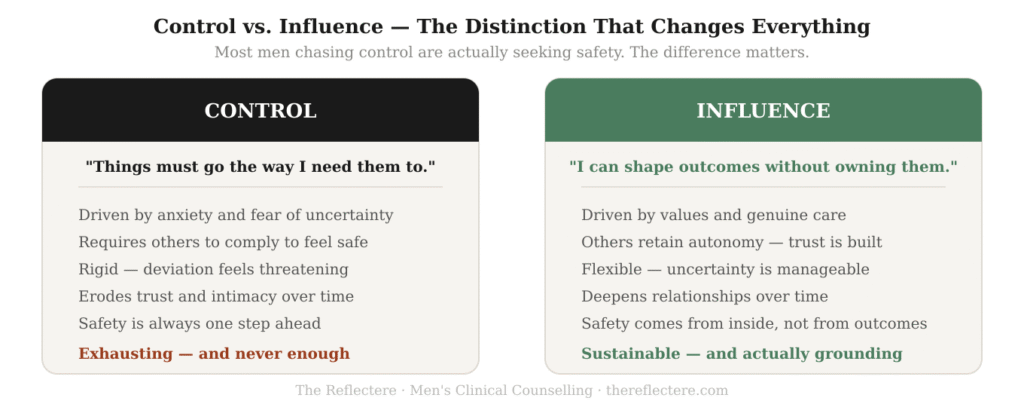
Control, in this context, isn’t about dominance or manipulation — though it can shade into those things. It’s more fundamental than that.
It’s the experience of internal safety being contingent on external outcomes. The man who needs to control his environment isn’t usually consciously aware that he’s anxious. What he’s aware of is that things need to be a certain way, and when they’re not, something unpleasant happens inside him — a tightening, a spike of irritation, a need to intervene and get things back on track.
That unpleasant feeling is anxiety. The controlling behaviour is the attempt to manage it before it arrives.
The pattern is logical if you understand where it comes from. At some point — often early, often in an environment that was genuinely unpredictable or unsafe — this man learned that staying in control of his circumstances was how you stayed safe. If he could anticipate problems before they arrived, if he could hold the variables in place, if he could ensure outcomes were what they needed to be, then nothing would catch him off guard in the way that being caught off guard once cost him something.
The adaptation made sense. The problem is that the nervous system that learned this lesson is still running the same programme in a life that is, by most measures, no longer unsafe. The alert system is overcalibrated. The controlling behaviour is protecting against a threat that isn’t there anymore — or at least, not to the degree it once was.
How It Shows Up in Men
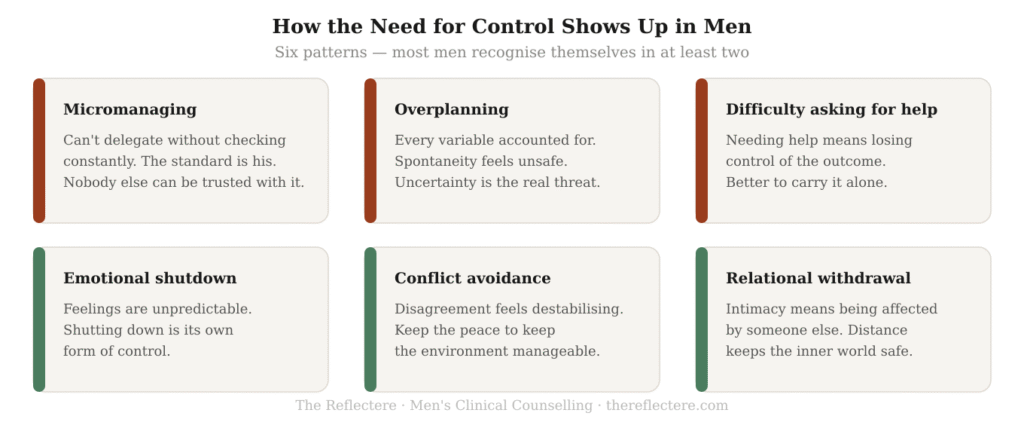
The need for control presents differently depending on the man, but there are patterns that appear consistently.
Micromanaging and Difficulty Delegating
The man who cannot hand a task to someone else without monitoring it closely, revising it afterwards, or simply doing it himself because it’s faster. This isn’t always arrogance about his own abilities — often it’s anxiety about the outcome. If he doesn’t control how it’s done, he can’t be sure it will be done right. And if it isn’t done right, something will go wrong. And something going wrong is the thing the whole system is organised to prevent.
The cost is significant: teams that can’t grow, partners who feel micromanaged in their own homes, children who don’t develop confidence because they’re never trusted to manage their own things.
Overplanning and Difficulty with Spontaneity
The man for whom uncertainty itself is the problem, not any specific uncertain outcome. He plans in detail not because he enjoys planning but because the act of planning makes the future feel more predictable, and predictability is how he keeps the anxiety manageable. Spontaneity feels dangerous — not because anything bad is actually likely to happen, but because the not-knowing is itself the threat.
Emotional Shutdown
This one surprises people because it doesn’t look like control from the outside — it looks like absence. But emotional shutdown is its own form of control: the control of the inner world rather than the outer one. Feelings are unpredictable. They arise without warning, they can’t be planned for, and they’re difficult to manage once they’ve arrived. Shutting down emotionally is a way of controlling the one thing that can’t be controlled externally — the experience of being affected.
The cost here is intimacy. The man who has learned to shut his internal world off as a control strategy is the same man who can’t be fully present with a partner or child, because presence requires being affected, and being affected means losing the control he’s depending on.
Conflict Avoidance
Not all controlling behaviour involves taking charge. Some men manage their environments by keeping everything smooth — avoiding disagreement, keeping the peace, not rocking the boat. This too is control: the control of other people’s emotional states, which feel threatening because when other people are upset, the environment becomes unpredictable. Conflict avoidance as a control strategy maintains the appearance of harmony while preventing the genuine resolution that actual relationships require.
Relational Withdrawal
The man who keeps people at a managed distance — enough connection to maintain the relationship, not enough to be genuinely vulnerable — is controlling for intimacy because intimacy means ceding control of how you’re affected. Being truly known by someone means they can hurt you in ways you didn’t anticipate. Keeping some of yourself back keeps that possibility contained.
The Relationship Between Control and Anxiety
The control and the anxiety are not separate problems. The anxiety is the root; the need for control is the management strategy that grew on top of it.
This matters because it shapes how the work needs to happen. Men who seek help for controlling behaviour — usually because someone in their life has named it as a problem — often approach it as a behaviour to be changed. And there are behavioural components to the work. But if you only address the behaviour without addressing the anxiety underneath it, you tend to get a man who has learned to hold himself back from the controlling behaviour but is still running on the same anxious engine. He’s white-knuckling the restraint rather than actually becoming less anxious.
The more fundamental work is with the anxiety itself — with what the nervous system learned about uncertainty and safety, and whether those lessons are still accurate.
Where It Comes From
The need for control typically has its roots in early experiences of unpredictability or threat — environments where something was genuinely out of control, and the child’s response was to find ways to manage as much as possible.
This could be overt: a chaotic home, an unpredictable parent, experiences of loss or instability that taught a young person that the world wasn’t safe to relax into. In those environments, developing the drive to control outcomes isn’t dysfunction — it’s intelligence. The child is doing exactly what survival requires.
More often, it’s subtler than that. The family that was functional but emotionally unpredictable — where a parent’s mood determined the temperature of the home, and reading and managing that mood became a skill the child developed out of necessity. The environment where making mistakes had significant consequences, and learning to prevent mistakes became the primary organising principle. The early experience of loss or disappointment that taught a boy, without words, that you couldn’t rely on things being okay.
These experiences don’t have to be dramatic to be formative. The nervous system learns from repeated smaller experiences as much as from singular big ones. And what it learns, once learned, continues to run — long after the original environment that taught the lesson has been left behind.
What Working Through It Looks Like
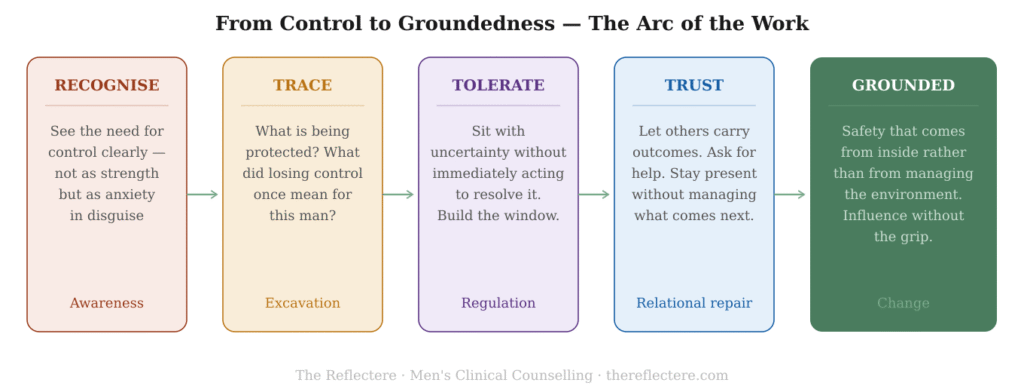
Seeing It Clearly
The first step is being honest about what’s happening. This requires some willingness to look beneath the behaviour at the experience underneath it — to notice that the irritation when plans change, or the difficulty handing things off, or the compulsion to check and recheck, isn’t about the specific situation. It’s about what the situation is triggering.
IFS is useful here. Working with the part of the internal system that needs control — understanding what it was trying to protect, what it believes will happen if it relaxes — allows a man to relate to the pattern with curiosity rather than being run by it. The controlling part isn’t the enemy. It’s a very hard-working protective part that learned its job a long time ago and hasn’t been told the threat has changed.
Understanding What’s Underneath
Once a man can see the pattern, the work moves to understanding its origins. This isn’t about blame — it’s about causality. Understanding that the need for control formed as an intelligent response to a specific set of experiences makes it possible to examine whether those experiences are still the relevant ones. Usually they aren’t, or not fully. The adult life doesn’t carry the same level of threat that the original environment did. The nervous system hasn’t received that update.
NARM is particularly useful at this stage, working with the developmental origins of the anxiety and the way early relational experiences shaped the man’s sense of what safety requires.
Building Tolerance for Uncertainty
The practical work involves gradually expanding the capacity to tolerate not-knowing without immediately moving to resolve it. Small, deliberate tolerations of uncertainty — letting someone else handle the outcome, not checking the work after it’s been delegated, staying in a difficult conversation rather than smoothing it over — are uncomfortable in the way that all exposure work is uncomfortable, and they’re also how the nervous system learns that uncertainty is survivable.
Somatic work supports this — learning to feel the activation that uncertainty produces in the body and stay with it rather than acting on it, building a nervous system that can hold discomfort without the discomfort immediately becoming behaviour.
Moving Toward Influence Rather Than Control
The destination isn’t passivity or indifference. It isn’t a man who stops caring how things go. It’s a man who can shape outcomes with skill and genuine investment without needing those outcomes to be guaranteed in order to feel safe.
That’s influence rather than control. High standards held from a place of care rather than fear. Involvement that leaves room for other people to be capable, for things to go differently than planned, for uncertainty to be part of living rather than a threat to be managed.
The man who has done this work is often, paradoxically, more effective than the man he was before — because he’s not spending enormous energy managing variables that don’t require managing. He can actually let some things go, and that lets him give his full attention to the ones that genuinely matter.
Book your free 20-minute consultation here →
FAQ — Control and Anxiety Counselling for Men
What does the need for control mean in men? The need for control in men is almost always a response to anxiety rather than a desire for dominance or power. When a man’s internal sense of safety depends on outcomes being predictable and environments being manageable, he will organise a great deal of his behaviour around keeping things in order — because disorder, at the level of the nervous system, registers as threat. The controlling behaviour isn’t about the specific things being controlled. It’s about managing the feeling underneath.
Is needing to be in control a sign of anxiety? Yes, in most cases. Anxiety and the need for control are closely linked because control is one of the primary strategies people use to manage anxiety. If I can predict and manage what happens, I can prevent the thing I’m afraid of. The problem is that this strategy is only temporarily effective — controlling the environment reduces anxiety in the short term but doesn’t address the underlying sensitivity to uncertainty that produces it. Over time, the range of things that need to be controlled tends to expand rather than contract.
How does the need for control affect relationships? Significantly, and in multiple directions. The man who needs to control outcomes will often micromanage partners in ways that erode trust and autonomy. He may be emotionally unavailable because genuine presence requires being affected, and being affected means ceding control of his inner experience. He may avoid conflict to keep the relational environment predictable, which prevents real resolution of genuine issues. And he may keep people at a managed distance because intimacy means allowing someone else to matter enough to hurt him — which is the one kind of uncertainty the control strategy can’t fully contain.
What’s the difference between being organised and needing to control everything? Being organised is a preference for structure that makes life more efficient. The need for control is an anxiety-driven compulsion in which deviations from structure produce a level of distress disproportionate to the actual stakes. The man who is organised can adapt when plans change — disappointed, maybe, but not destabilised. The man with a significant need for control finds plan changes genuinely threatening, not because of the practical implications but because unpredictability itself feels unsafe. The distinction is in the emotional stakes attached to the outcome, not the preference for order.
What therapy helps men with control and anxiety? At The Reflectere, work with control and anxiety draws on IFS to understand the protective parts that developed the need for control and what they’re still working to prevent. NARM addresses the developmental origins of the anxiety — the early experiences that taught the nervous system that uncertainty was dangerous. Somatic Therapy builds the capacity to tolerate uncertainty in the body without immediately converting it into controlling behaviour. The ARC framework — Awareness, Regulation, Change — provides the structure: from recognising the pattern, to regulating the anxiety underneath it, to choosing differently in the moments that previously triggered the need to control.
Do you offer counselling for men with anxiety and control issues virtually in BC? Yes. The Reflectere offers virtual counselling for men dealing with anxiety, the need for control, and related patterns across British Columbia and parts of Canada. A free 20-minute consultation is available at thereflectere.janeapp.com.
The Reflectere offers in-person men’s counselling in Kelowna, BC and virtual counselling for men across British Columbia and Canada. Therapeutic approaches include IFS, Somatic Therapy, NARM, CBT, and DBT.