




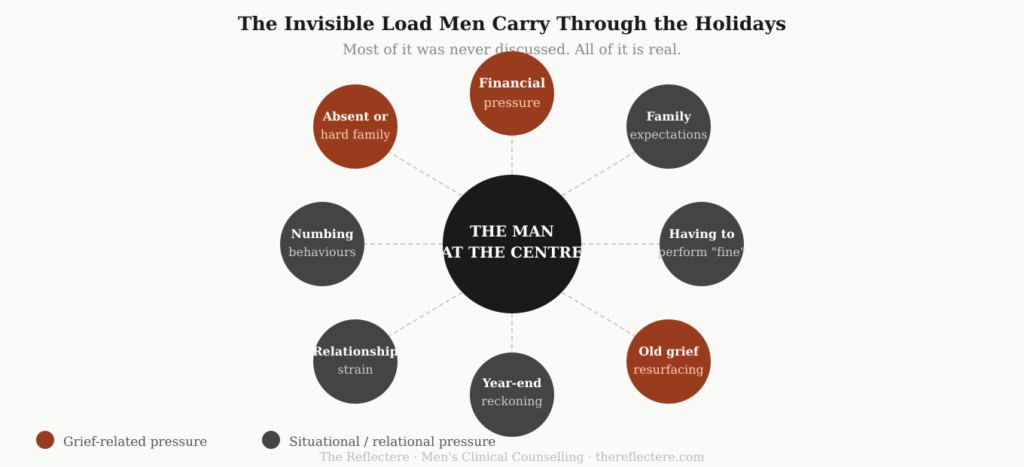
The holiday season is one of the most emotionally loaded times of year for men — not because of the celebrations, but because of everything underneath them. Financial pressure, family obligations, the surfacing of old grief, the gap between how the season is supposed to look and how it actually feels, and the year-end reckoning that arrives whether a man is ready for it or not. Most men manage this by pushing through, staying busy, and performing fine — which works until it doesn’t, and costs more than it appears to. Holiday stress counselling for men focuses on identifying what’s actually hard, building enough self-awareness to manage it without shutting down, and entering January with something more than just the relief that it’s over.
Why the Holidays Hit Differently for Men
There’s a particular kind of exhaustion that arrives in December for a lot of men, and it doesn’t come from the busyness — or not only from that. It comes from carrying a season that asks a great deal while offering almost no space to put any of it down.
The cultural script for men at this time of year is familiar: provide, show up, hold it together, make it good for everyone else. Keep the finances manageable. Navigate the family dynamics without making anything worse. Be present at the table without taking up too much space with whatever you’re actually feeling. Perform the warmth and the gratitude and the togetherness. Keep the lid on.
Most men do this. They do it well, actually. And they arrive in January running on empty, slightly irritable in a way they can’t quite explain, wondering why the holidays didn’t feel the way they were supposed to.
The answer is usually that they were so focused on managing the season that they never actually inhabited it.
What Men Are Actually Carrying
The holiday season doesn’t create new difficulties for men so much as it intensifies the ones already there, while removing the usual buffers — the work routine, the structure, the distance from family, the ability to stay busy enough that things don’t quite catch up.
Financial Pressure
December is expensive, and for men who carry the weight of providing — or who feel they should — the financial pressure of the season can be significant. The gap between what the season seems to call for and what’s actually manageable produces a low-grade stress that doesn’t go away and rarely gets spoken aloud. Men often absorb this silently, treating it as a problem to be managed rather than a pressure to be acknowledged.
Family Dynamics and Old History
The holidays bring people together who don’t necessarily have easy relationships. For many men, returning to family of origin — or hosting extended family — means navigating old dynamics that were never resolved. The family system that was difficult in childhood is still difficult, even when everyone is now adults. Old roles reassert themselves. The things that were never spoken about remain unspoken. And the expectation that this should be a time of warmth and connection sits in uneasy tension with relationships that are, in reality, complicated.
Grief That Surfaces
The holidays are one of the most common times for unprocessed grief to rise. Loss is amplified by the contrast between what the season is supposed to feel like and the specific person or thing that isn’t there. The first Christmas after a death. The season that marks the anniversary of a divorce. The year where whatever was supposed to have happened by now hasn’t. The empty chair, the missing call, the absence that everyone notices and nobody says anything about.
Men who have never been given permission to grieve carry those losses into every holiday season, and the season makes them harder to ignore. The grief often surfaces not as sadness but as the other things — the irritability, the flatness, the urge to get through it rather than be in it.
The Year-End Reckoning
December carries an accounting quality that most men find uncomfortable. The year is ending. Something was supposed to happen that didn’t. Something was attempted and fell short. The relationship is in the same place it was twelve months ago. The goals set in January are being quietly retired without acknowledgment.
Men who hold themselves to high standards — and many men do — tend to do this accounting harshly. The gap between where they imagined they’d be and where they actually are gets evaluated like a performance review, with the man giving himself the failing grade.
This isn’t useful, but it’s very common. And it compounds everything else that makes the season hard.
The Performance of Fine
Underneath all of it is the expectation — from outside and from inside — that a man keep it together. That whatever is hard be kept private. That the people he loves be protected from the difficulty of his actual experience. That the season be held together by his competence and reliability, as it always has been.
The performance is exhausting. And it’s invisible to almost everyone around him, which means he receives almost no acknowledgment for it.
What This Time of Year Actually Needs From Men
This is not a section about lowering your standards or opting out of your responsibilities. It’s about the difference between going through the season and actually being in it.
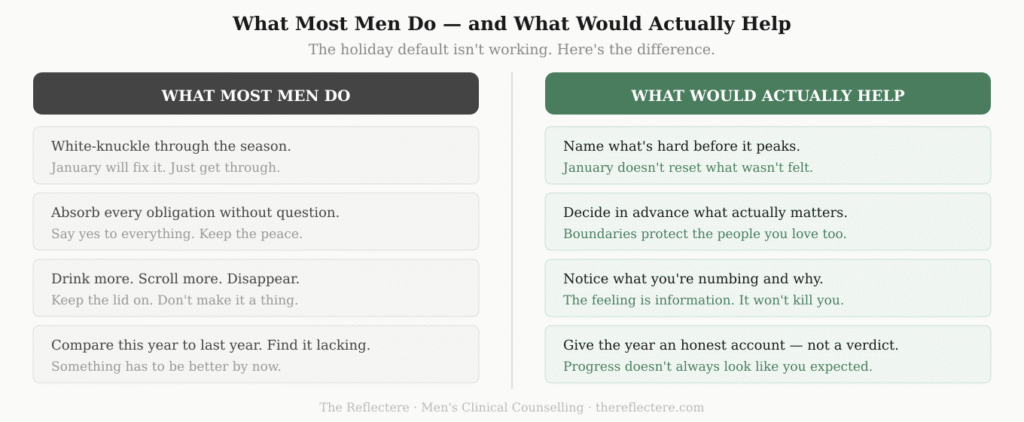
Name what’s hard before it peaks. The men who get to the other side of December in reasonable shape are usually the ones who were honest with themselves — and sometimes with someone close to them — about what was going to be difficult before it arrived. Not to solve it. Just to acknowledge it. That act of naming reduces the pressure that builds when difficult things are carried silently.
Give grief something. If someone is missing from your season — if there’s a loss this year has carried — it deserves more than being pushed through. Even a brief, deliberate acknowledgment: this is hard, and that’s because it matters.Grief that isn’t given any space doesn’t disappear. It converts into the irritability and the flatness and the absence that the people around you notice even when they don’t say anything.
Notice what you’re managing with. The increase in alcohol, the extra hours of scrolling, the need to stay constantly busy — these are worth looking at honestly. Not with judgment. With curiosity. What is this keeping at a distance? What would I feel if I stopped? Those questions don’t require dramatic action. They just require honesty.
Give the year an account, not a verdict. The year-end reckoning doesn’t have to be a performance review. It can be a genuine accounting of what was hard, what moved, what was attempted, what was learned. Progress doesn’t always look like the original plan. Something being different from what you expected isn’t the same as it being less.
A Check-In Worth Taking
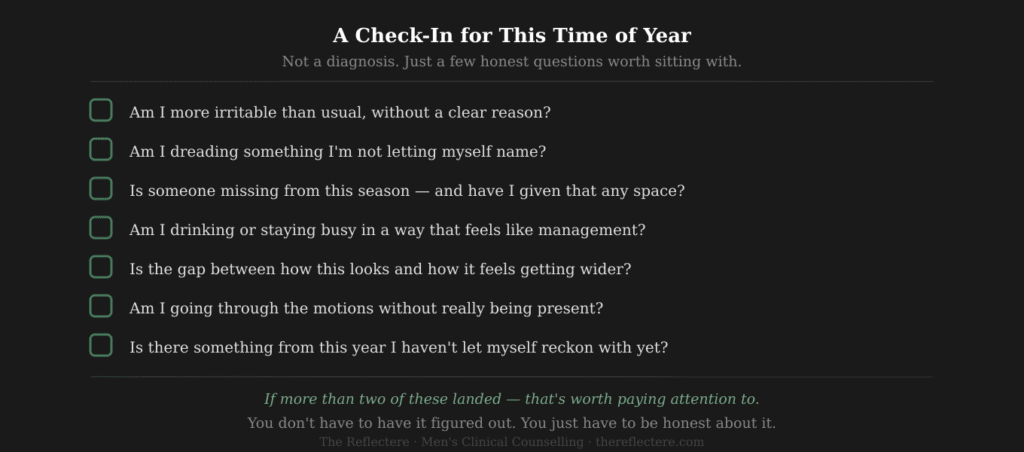
The seven questions in the visual above aren’t a diagnostic tool. They’re just invitations to be honest with yourself about what this season is actually carrying.
If more than two of them landed — if reading them produced a flicker of recognition — that’s worth paying attention to. Not because something is wrong, but because something is real. And real things, given attention, tend to be more manageable than real things that are being managed without acknowledgment.
The holiday season doesn’t have to be transformed. It doesn’t have to become something it isn’t. It just has to be met honestly — with enough self-awareness to know what you’re actually carrying, enough courage to give some of it a name, and enough patience with yourself to not require the season to be better than it is.
That’s usually enough. And it tends to leave men somewhere better in January than the alternative.
Book your free 20-minute consultation here →
FAQ — Holiday Stress and Men’s Mental Health
Why do men struggle with the holidays? The holidays intensify the pressures men already carry while removing the usual buffers — work routine, structure, distance from difficult family dynamics, the ability to stay busy enough that harder feelings don’t surface. Men are expected to provide, hold it together, and perform warmth and togetherness, often while managing financial pressure, unresolved family history, surfacing grief, and a year-end reckoning with what didn’t go as planned. Most men do this silently, which is why the exhaustion that follows the season often comes as a surprise — it built in ways that were never acknowledged.
Is holiday depression common in men? Yes, though it often doesn’t look like depression in the clinical sense. Men are more likely to present with irritability, emotional flatness, withdrawal, increased drinking, compulsive busyness, or a vague sense of going through the motions without being present. These are the same presentations that characterise unprocessed grief and suppressed emotional material — the holiday season brings both to the surface by contrast. When every surrounding message is about warmth and connection, the gap between that and a man’s actual experience becomes harder to ignore.
How does grief affect men during the holidays? The holidays are one of the most common times for unprocessed grief to surface. Loss is amplified by contrast — the absence of someone who should be there, the first season after a significant ending, the year that was supposed to be different. Men who haven’t been given permission to grieve carry those losses into every holiday season, and the season makes them harder to suppress. The grief typically surfaces not as sadness but as anger, flatness, or the urge to get through rather than be in the season. Giving that grief even a brief, deliberate acknowledgment — rather than pushing through it — tends to make the season significantly more manageable.
What is year-end reckoning and why does it affect men? Year-end reckoning is the natural accounting that arrives as the year closes — looking at where you are versus where you expected to be, what was attempted and fell short, what was planned and went differently. For men who hold themselves to high standards, this accounting tends to be harsh: the gap between expectation and reality is evaluated like a performance review, with the man delivering a failing grade. This isn’t useful, but it’s very common. The more helpful version is an honest account rather than a verdict — including what was hard, what moved, what was attempted, and what was learned — rather than a simple measure of whether goals were achieved.
How can men manage holiday stress better? The most effective things are usually the least dramatic: naming what’s going to be hard before the season peaks, giving unacknowledged grief some deliberate space, noticing when numbing behaviours are increasing and what they’re managing, and approaching the year-end review with honesty rather than harshness. These don’t require the season to become something it isn’t. They just require enough self-awareness to know what’s actually being carried — which is more manageable than the alternative of carrying it silently until it becomes something harder to ignore.
Do you offer counselling for men around holiday stress in BC? Yes. The Reflectere offers virtual counselling for men dealing with holiday stress, grief, family dynamics, and year-end anxiety across British Columbia and parts of Canada. Sessions are tailored to how men actually experience these pressures — practically, without performative emotional processing, and with real tools for managing what surfaces at this time of year. A free 20-minute consultation is available at thereflectere.janeapp.com.
The Reflectere offers in-person men’s counselling in Kelowna, BC and virtual counselling for men across British Columbia and Canada. Therapeutic approaches include IFS, Somatic Therapy, NARM, CBT, and DBT.