




Men who struggle in their closest relationships are rarely struggling because they don’t care. More often, they’re struggling because the relational skills that would serve them in a partnership — staying present under emotional pressure, tolerating vulnerability without shutting down, hearing criticism without converting it into a threat — were never developed. The patterns that protect men in other areas of life (self-sufficiency, emotional control, staying functional under pressure) tend to work against them in intimate relationships, where being affected, being known, and being honest about difficulty are what connection actually requires. Relationship counselling for men in BC focuses on the specific patterns that create distance, what drives them, and how to build the relational capacity that most men were simply never taught.
Why Men Struggle in Their Closest Relationships
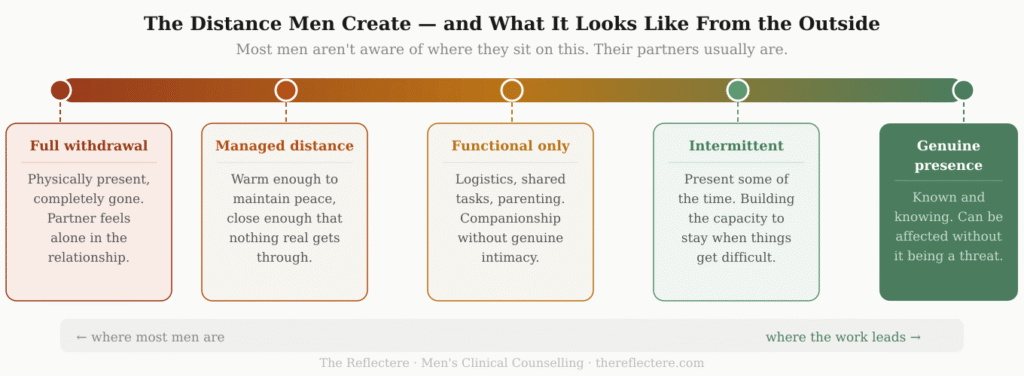
There’s a particular gap that shows up in a lot of men’s relationships — between how much they care about the person they’re with and how little that care actually translates into the kind of connection their partner is looking for.
It’s a gap that produces a lot of confusion on both sides. The man can’t understand why his partner says she feels alone when he’s right there. The partner can’t understand why he seems so present in every other area of his life and so absent in this one.
The honest answer, usually, is not that the man is withholding. It’s that he genuinely doesn’t know how to do what’s being asked of him. The relational skills his partner needs — emotional attunement, the capacity to be affected without shutting down, the ability to stay in a difficult conversation without leaving or defending — are skills that most men were never taught, never modelled, and never encouraged to develop.
What they were taught, most of them, was something that looks like its opposite: manage your emotions, stay functional, don’t make things worse by putting your difficulty in the room. Those lessons made sense in the contexts where they were learned. In an intimate relationship, they tend to produce the distance that slowly erodes the connection.
The Patterns That Create Distance
Most relational difficulty in men doesn’t come from a single dramatic failure. It comes from a set of recurring patterns — small moves, made habitually, that add up over time to a significant gap between two people.
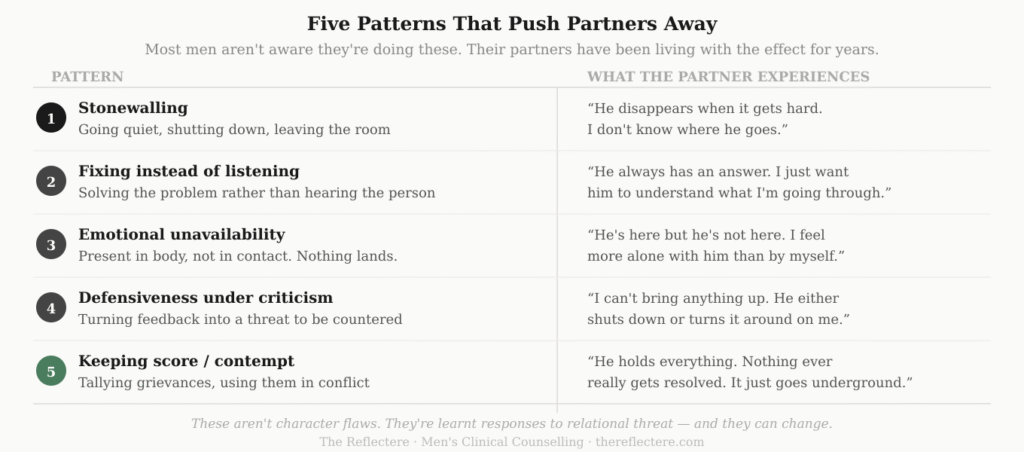
Stonewalling
Stonewalling is what happens when the nervous system gets overwhelmed in a relational conflict: a man goes quiet, withdraws, leaves the room, or simply becomes unreachable. From the inside, it often feels like a reasonable response — a way of preventing things from getting worse, of not saying something regrettable. From the outside, it reads as abandonment. The partner is left trying to have a conversation with someone who has left, emotionally if not physically. The issue that prompted the conversation doesn’t get addressed. It goes underground, where it compounds.
Stonewalling is one of the strongest predictors of relational deterioration over time, and it’s also one of the most automatic responses men produce — not because they don’t care, but because their system has learned that withdrawal is the safest option when relational stakes are high.
Fixing Instead of Listening
Men are, in general, oriented toward problem-solving. When someone they care about brings them a difficulty, their first instinct is usually to find the solution — to fix it, resolve it, make it better. This can feel like care in action. What it often misses is that the person sharing the difficulty wasn’t asking for a solution. They were asking to be understood.
The experience of being immediately redirected to a solution — when you’ve brought something hard and the response is a plan rather than acknowledgment — is of not being heard. The man offering the solution often doesn’t understand why the response isn’t gratitude. The partner offering the difficulty often doesn’t understand why they feel more alone after sharing it than before.
Emotional Unavailability
This one is harder to name than the others because it doesn’t look like anything specific. The man is present. He’s not doing anything wrong, exactly. But there’s a kind of contact missing — a sense that nothing actually lands, that he’s managing his responses rather than genuinely having them, that she can reach him logistically but not emotionally.
Partners often describe this as feeling more alone with the person than they would be by themselves. It’s the loneliest form of relational distance because there’s no behaviour to point to — just an absence that’s very hard to put into words.
Defensiveness Under Criticism
For many men, criticism — even gentle, carefully framed criticism — is experienced as a threat. The response is defensive: denying, deflecting, turning the concern around, countering with grievances of their own. The function of the defensiveness is protection. The effect is that nothing the partner raises can actually land, because every piece of feedback activates a defensive response rather than genuine consideration.
Partnerships accumulate a lot of feedback over time. Relationships where that feedback can’t be received tend to calcify around the same unresolved issues for years. The man believes he’s protecting himself from unfair attack. The partner comes to believe that there’s no point in raising anything, because it won’t be heard.
Keeping Score
Some men maintain an internal ledger of grievances — things the partner did or didn’t do, things that were said, old wounds that never healed. The ledger gets used in conflict: when something arises, historical evidence is marshalled. The function is to maintain a kind of relational fairness. The effect is that nothing ever actually resolves. Issues from years ago can resurface in an argument that started about something completely different. The partner comes to feel that the past is always present and always usable against them. Genuine repair becomes difficult when there’s a stockpile of evidence on one side.
What Men Get Wrong About What Their Partners Need
A lot of relational difficulty in men is driven not by bad intentions but by mistaken assumptions — a genuine mismatch between what a man believes his partner is looking for and what she’s actually looking for.
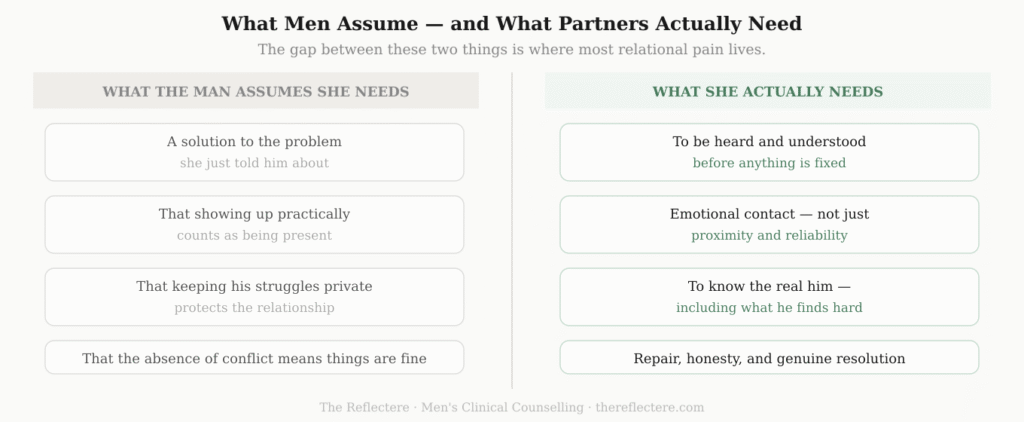
The most common version of this is the fixing problem: a man who shows up to a difficult conversation with a solution believes he is demonstrating care. His partner, who wanted to feel understood before anything was fixed, experiences the solution as a way of ending the conversation rather than engaging with it. Both people leave the exchange with an accurate account of what happened and opposite interpretations of what it meant.
The same gap shows up with practical presence. Many men believe that showing up reliably — earning, managing, handling the tasks — constitutes a form of care that should register with their partner. And it does register. But it doesn’t substitute for emotional contact, and when a partner says she feels alone or unseen, she is usually pointing at the absence of that contact rather than the absence of practical contribution.
The most consequential version of this mistaken assumption is around privacy. Many men keep their own difficulty, their own struggles, their own fears, to themselves — genuinely believing that this protects the relationship. That if they were to put their own difficulty in the room, it would be a burden, an imposition, a reason for concern. The experience from the partner’s side is usually opposite: she doesn’t know the real version of him. She knows the managed version. The version that’s always fine. And being with someone who is always fine is isolating — because it places the entire emotional weight of the relationship on her side of the room.
What It Actually Takes to Close the Gap
None of this requires a man to become someone he isn’t. The capacity for genuine relational presence isn’t about performing sensitivity or processing emotions in ways that feel foreign. It’s about developing the specific skills that allow connection to actually happen — which, like any skill, can be built.
The first shift is staying when it gets difficult. Most relational ruptures happen not in the conflict itself but in the withdrawal from it. A man who can stay present under emotional pressure — who doesn’t stonewall, who doesn’t leave the conversation — has already changed the conditions for connection. Staying doesn’t mean having the right answer. It means not withdrawing.
The second is hearing before fixing. This is a small change in sequencing that makes a significant difference: before moving to a solution, ensuring the person feels understood. This isn’t passive. It’s a deliberate act of attention. What is she actually trying to tell me? Have I understood it? Have I said so? When those questions get answered honestly, the conversation changes.
The third is allowing yourself to be known. This is the one most men find hardest. Putting genuine difficulty into the room — not managed updates, not the fine version, but the actual thing that’s hard — changes the relational dynamic in ways that most men find surprising. Partners who have been trying to reach someone for years often describe this as a turning point. It turns out that the thing he was withholding to protect the relationship was the thing the relationship most needed.
These shifts don’t happen in one conversation. They build through practice, through small acts of remaining present when the instinct says to leave, through the gradual discovery that relational risk — the risk of being known — doesn’t produce the consequences that fear said it would.
That’s what therapy for men working on their relationships is usually about. Not fixing what’s broken. Building what was never there to begin with.
Book your free 20-minute consultation here →
FAQ — Men and Relationship Problems
Why do men struggle in relationships? Men who struggle in relationships are almost never short on care. What they’re typically short on is relational skill — specifically, the capacity to stay emotionally present under pressure, to tolerate vulnerability without shutting down, and to hear feedback without converting it into a threat. These aren’t character failings. They’re gaps in development: skills that weren’t modelled, weren’t taught, and weren’t encouraged. The same qualities that make men functional in other areas of life — emotional control, self-sufficiency, staying calm under pressure — tend to work against them in intimate relationships, where being genuinely affected and emotionally available is what connection requires.
What is emotional unavailability in men? Emotional unavailability in men describes a state of being physically present while remaining emotionally unreachable — managing responses rather than genuinely having them, maintaining a surface of functionality while keeping the deeper experience private. It often isn’t a deliberate choice. Many men who are emotionally unavailable don’t know it. What they know is that their partner says she feels alone, and they don’t understand why, because they’re right there. The experience from the partner’s side is of being unable to actually reach him — of having access to his logistics and his competence but not to the person underneath. It is one of the most common patterns in men’s relationships and one of the most responsive to therapeutic work.
What causes men to stonewall? Stonewalling — going quiet, withdrawing, becoming unreachable during conflict — is typically a nervous system response rather than a deliberate strategy. When relational stakes are high and the emotional load exceeds what a man’s system can manage, withdrawal is the fastest way to reduce the intensity. The problem is that the partner experiences it as abandonment rather than self-regulation, and the original issue doesn’t get addressed. Over time, stonewalling produces a pattern where the same conflicts resurface repeatedly without resolution, because one person consistently leaves before they can be worked through. Learning to tolerate relational distress without withdrawal is a core part of relationship counselling for men.
Can men change their relationship patterns with therapy? Yes. Relational patterns in men — stonewalling, defensiveness, emotional unavailability, fixing instead of listening — are learnt responses, not fixed traits. They were adaptive in the contexts where they developed, and they can be changed in a context that supports something different. Therapy for men working on relationships focuses on what’s driving the pattern beneath the surface, what it’s protecting against, and how to build the specific relational capacities — staying present under pressure, tolerating vulnerability, hearing feedback without defending — that allow genuine connection to happen. Change tends to be gradual and practice-based, but it is reliable when the man is genuinely engaged with the work.
How do I know if I need relationship counselling? The clearest signal is a persistent gap: between how much you care about the relationship and how well that care seems to translate into the connection your partner is looking for. Other signals include recurring conflicts that don’t resolve, a sense that your partner feels unknown to you or you feel unknown to her, increasing distance that neither of you knows how to close, and patterns that you recognise but don’t know how to change — stonewalling, defensiveness, withdrawal. Men often seek relationship counselling after a crisis (a separation, a disclosure, a confrontation that couldn’t be avoided), but the work is more effective and less painful when it starts before the crisis point.
Do you offer relationship counselling for men in BC? Yes. The Reflectere offers individual relationship counselling for men — focused on the patterns that create relational difficulty, what drives them, and how to build genuine relational capacity — in Kelowna, BC, and virtually across British Columbia and parts of Canada. This isn’t couples therapy (though that can be appropriate in some situations). It’s individual work with men who want to understand their own relational patterns and build something different. A free 20-minute consultation is available at thereflectere.janeapp.com.
The Reflectere offers in-person men’s counselling in Kelowna, BC and virtual counselling for men across British Columbia and Canada. Therapeutic approaches include IFS, Somatic Therapy, NARM, CBT, and DBT.